
Structured Focus Intervals
Learn how structured focus intervals like the Pomodoro technique improve productivity with timed work and breaks for better concentration.
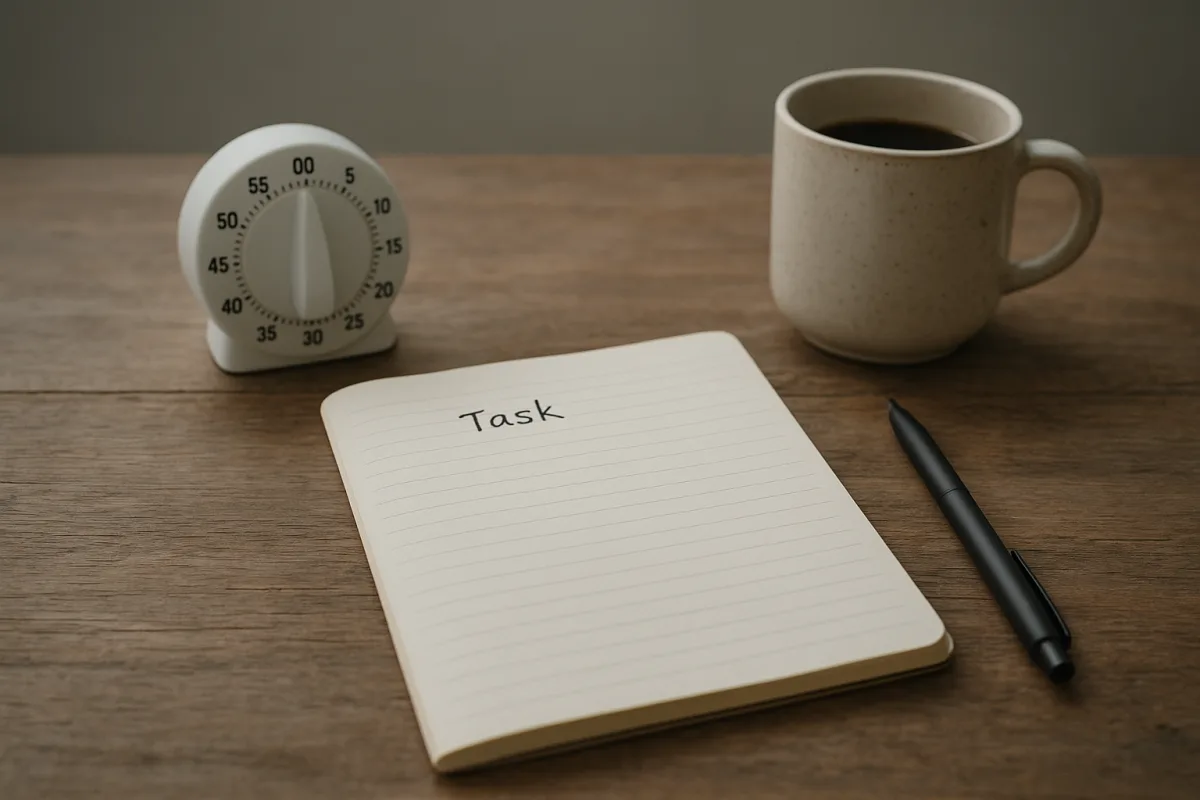
The focus technique worth understanding properly: structured intervals
The most useful focus technique for ordinary desk work is not a complicated app, a perfect morning routine or an attempt to become permanently distraction-proof. It is structured work intervals, usually known as the Pomodoro Technique.
The standard version is simple: choose one task, work on it for 25 minutes, take a five-minute break, and repeat. After four work intervals, take a longer break, often 15 to 30 minutes. [10]
That description is accurate but incomplete. The timer is not the method. The method is an agreement about what happens before, during and after a bounded stretch of work.
Before the interval, you decide what one piece of work deserves the next 25 minutes. During it, you do not switch to email, messages, browser tabs or “quick” administrative jobs. After it, you stop briefly rather than sliding into another hour.
This is useful because attention is not just about willingness. Every switch carries a reorientation cost: recalling what you were doing, reconstructing the next step, and resisting whatever the interruption offers instead. Research cited by the American Psychological Association estimates that multitasking can reduce efficiency by as much as 40 percent through these switch costs. [10]
A timer does not eliminate interruptions. It does make them visible. If a message arrives during an interval, the practical response is to write it down and return to the task, unless it genuinely requires immediate action.
That small act matters. Without it, people often replace a difficult task with a low-stakes one, then call the resulting activity “being responsive.” The day can feel full while the work requiring concentration remains untouched.
What the 25-minute number actually does
The 25-minute interval is often presented as though it were a scientifically ordained unit of human attention. It is not. The research brief supports structured intervals as a way to sustain attention and reduce fatigue, but it also notes that the optimal duration varies by person and task.
Twenty-five minutes is better understood as a design choice. It is short enough to lower the psychological cost of starting a task you have been avoiding. It is long enough to get beyond the first few minutes of setup, rereading and settling in.
For many knowledge tasks, the first five minutes are not productive in any glamorous sense. You open the document, find the relevant notes, remember the argument, locate the spreadsheet column, or reread the previous paragraph.
A 25-minute boundary tells you that this setup has somewhere to go. You are not committing to “finish the report” or “write all afternoon.” You are committing to remain with the report until the timer ends.
That is particularly useful when the work is vague. “Work on strategy” is hard to begin because it contains too many possible actions. “List three unresolved decisions in the strategy document for 25 minutes” is a task with edges.
The number also creates a stopping point. That is a cost as well as a benefit. If you are deeply absorbed at minute 24, an alarm can be disruptive. You do not need to obey it theatrically.
A more workable rule is to finish the sentence, calculation or thought you are in, write a one-line note about the next step, then take the break. The break remains part of the system, but it need not sever work at the least convenient word.
What a real cycle asks of you
A functioning interval practice has four parts: task selection, protection, a break, and a record. Leaving out any one of them tends to turn it into another timer you ignore after three days.
Task selection means choosing work small enough to move in one interval, or defining a clearly bounded slice of a larger project. “Prepare the presentation” is a project. “Draft the three-slide outline” is an interval-sized commitment.
Protection means deciding in advance what counts as an interruption. Put the phone out of reach, close irrelevant tabs, silence non-urgent notifications, and tell colleagues when you will next be available if your role permits it.
This is not an argument for treating every message as an intrusion. Some jobs require monitoring a queue, responding to clients or coordinating a team in real time. In those roles, uninterrupted intervals may need to be scheduled around coverage rather than imposed across the day.
The five-minute break is not a reward for virtue. It is the part that makes repeated intervals plausible. Stand up, get water, look away from the screen, or do something physically different from the task.
What tends not to work is using the break to open a social feed, inbox or news site. Those services are designed to supply more material than five minutes can contain. You return with an unfinished thread in your head.
The record can be as simple as a tick mark beside the task. At the end of the day, it tells you whether a project received focused time, rather than whether you felt busy.
That record is also useful for planning. If a task repeatedly takes four intervals when you estimate one, the problem may be the estimate, the task definition, missing information, or an obstacle you have not named.
The review is where the technique becomes a system
Planning a block of focus time once is not enough. Guidance on productivity systems consistently identifies regular daily, weekly and monthly review as necessary because priorities, constraints and estimates change. [11]
A daily review can take five minutes. Look at unfinished tasks, decide whether they still matter, and identify the first interval for tomorrow. This prevents the timer from becoming a machine for avoiding decisions.
A weekly review is more important for projects that sprawl. Count where your focused intervals went. If every week says “administration” and none says “the work that advances the project,” the issue is not a shortage of apps.
The review also reveals whether the method fits the work. A writer may need several uninterrupted intervals for drafting. A support worker may be more effective with short response windows between scheduled focus blocks. Neither pattern is a moral achievement.
Longer hours are not a substitute for this design. Productivity per hour reportedly drops sharply after 50 hours a week, with near-zero gains beyond 55 hours. [10] Adding more intervals to an overextended week usually creates more recorded effort, not proportionally more useful output.
Where structured intervals break
The technique breaks first when the task cannot be meaningfully paused. A receptionist, emergency worker, live operations coordinator or parent caring for a child may not control 25 uninterrupted minutes. That is a condition of the work, not a failure of concentration.
It also breaks when the interval is used to avoid collaboration. Some work becomes worse when every person protects private focus time and no one answers the questions blocking everyone else. Team agreements about availability matter more than individual timer discipline.
Remote workers can be particularly exposed to the multitasking problem because home distractions and digital communication compete in the same space. [12] But a strict timer is not automatically the answer if household responsibilities make fixed blocks unrealistic.
The technique is also poorly suited to tasks requiring long incubation, such as complex research, difficult design or resolving a conceptual problem. You can use intervals for reading, note-making or analysis, but a timer cannot force an insight on schedule.
Do not mistake discomfort for evidence that you need a shorter interval. Difficult work often feels difficult for the first ten minutes. But if you repeatedly cannot begin, investigate the task definition before assuming you need more discipline.
Finally, it is not an appropriate response to ongoing concentration changes, severe tiredness, insomnia, anxiety, depression or other health concerns. A focus method can structure a work session. It cannot diagnose why attention has changed.
How to adjust the interval without endlessly optimising it
Start with the conventional 25 minutes of work and five minutes of rest for one week. Change only one variable at a time, otherwise you will not know whether the duration, task type or environment made the difference.
Try 15 or 20 minutes if you are returning to demanding work after an interruption-heavy period, if the task is emotionally resistant, or if your workday comes in short gaps. The aim is a completed block, not a heroic block.
Try 40 to 50 minutes for work with substantial setup costs, such as programming, analysis, editing or drafting. Only do this if you can still take a real break and can reliably avoid switching tasks during the longer session.
Do not extend intervals simply because 25 minutes now feels easy. Easy may mean you have found a workable boundary. The relevant measure is whether you return to the task, make visible progress and still have usable attention later.
Environmental adjustments can help, though the evidence does not support one universal perfect setup. Office research links illuminance above 500 lux and melanopic lux above 150 with better productivity-related outcomes, while colour temperature between 3000 K and 6500 K can affect mental workload. [1]
Noise is similarly individual. Research comparing office noise around 50 dB(A) and 70 dB(A) finds effects on reading comprehension, moderated by the person and the nature of the sound. [1] Start by reducing controllable interruptions, not by buying equipment.
Where apps help, and where they add another layer
A basic kitchen timer, phone timer or calendar block is sufficient for structured intervals. Apps are useful only if they remove a practical obstacle, such as blocking distracting sites or recording sessions automatically.
Freedom is a distraction-blocking service priced at $8.99 monthly, $39.99 annually or $299 for lifetime access. It suits someone who repeatedly overrides their own intention by opening the same sites across devices. [14]
Forest uses a game-like growing-tree mechanic. It is $3.99 as a one-time iOS purchase, while Android offers a free ad-supported version or a $1.99 ad-free option. It suits people who find a visible, low-stakes commitment helpful. [15]
Opal Pro combines blocking with AI coaching. It has a free tier, while Pro costs $9.99 a month or $79.99 a year. It suits users who want more structure, though coaching prompts can become another thing to manage. [15]
Brain.fm sells AI-generated focus music for $9.99 monthly or $49.99 annually. It may suit people who work better with consistent non-verbal sound, but it is not evidence that music will improve focus for everyone. [15]
Apple Creator Studio costs $12.99 monthly or $129 annually, with student discounts, and bundles creative and productivity software. It suits people already working in Apple’s ecosystem, not someone seeking a dedicated focus timer. [16]
ChatGPT has a free tier, Go at $8 monthly and Plus at $20 monthly. It may suit people who use it to turn a vague task into a first draft, outline or checklist, but it can also create more material to evaluate. [17]
The recurring mistake is assuming that a paid tool produces focus. Tools can make the boundaries easier to hold. They cannot choose the right task, protect your capacity, or replace the regular review that tells you whether the system is helping.
Frequently Asked Questions
What are structured focus intervals and how do they improve productivity?
Structured focus intervals involve working on a single task for a set period, typically 25 minutes, followed by a short break. This method reduces task-switching and fatigue by limiting interruptions and reorientation costs, which can reduce efficiency by up to 40%. The intervals help maintain sustained attention and prevent the workday from being consumed by low-stakes distractions.
How long should work intervals be for optimal focus?
The standard work interval is 25 minutes, but this is a starting point rather than a fixed rule. The optimal length varies by person and task; intervals can be shortened for fragmented work or lengthened only if you can reliably return to the task after breaks. The key is to choose an interval long enough to move beyond initial setup but short enough to lower the psychological cost of starting.
Why does the Pomodoro technique use 25-minute intervals?
The 25-minute interval is a design choice rather than a scientific constant. It balances being short enough to make starting less daunting and long enough to get past the first few unproductive minutes of settling into a task. This duration helps create a clear stopping point and commits you to focused work without requiring completion of the entire project in one go.
How can I protect my focus during work intervals?
Protecting focus means deciding in advance what counts as an interruption and minimizing them accordingly. This includes putting your phone out of reach, closing irrelevant tabs, silencing non-urgent notifications, and informing colleagues when you will be available. If interruptions occur, note them to address later rather than switching tasks immediately.
What should I do during breaks in structured focus intervals?
Breaks are meant to make repeated intervals sustainable by providing physical and mental rest. Use the five-minute breaks to stand up, get water, or look away from the screen—engage in something physically different from the work task. Avoid opening social media, email, or news sites during breaks, as these can create unfinished mental threads that disrupt focus on return.
How we researched this
This article was assembled from 18 cited references.
Nothing here is based on hands-on testing. Where a figure or finding appears, it belongs to the source cited beside it, and the writing says so rather than implying otherwise. Every source is listed below so you can check it.
Sources
- Effect of lighting illuminance and colour temperature on mental workload in an office setting | Scientific Reports
- Effects of nature-adapted lighting solutions ("Virtual Sky") on subjective and objective correlates of sleepiness, well-being, visual and cognitive performance at the workplace.
- How to Improve Concentration: 10 Science-Backed Strategies That Actually Work | Brain Zone
- How to Improve Focus and Concentration Naturally — 8 Strategies Ranked
- Best Focus Techniques (That Actually Work) | NeuroLifts
- How to Improve Concentration: 14 Tips to Help You Focus
- Time Blocking in 2026: The Trends, Research & Tips That Actually Work
- Effect of Color Temperature and Illuminance on Psychology, Physiology, and Productivity: An Experimental Study | MDPI
- You’re Destroying Your Deep Work—Stop These Productivity-Killing Focus Mistakes Now - Productivity News
- 15 Productivity Techniques Backed by Science (2026) | What Actually Works
- Top 10 Productivity Myths (and What Actually Works in 2026)
- 10 Remote Work Productivity Mistakes to Avoid 2026
- Managing change in multicultural organisations: cultural alignment, structured frameworks and project success in the UN system | International Journal of Organizational Analysis | Emerald Publishing
- Best Time Management Apps in 2026: Ultimate Productivity Guide | WorkSnaply
- Best Focus Apps in 2026: Top Picks for Deep Work & Productiv | Atom Up
- iLife and iWork strike back - Apple's putting all of its creative and productivity apps under one subscription, Apple Creator Studio, and it's multiplatform across macOS, iOS, and iPadOS
- Best Productivity Tools in 2026 | Toolradar
- Optimal type and dose of exercise for improving executive functions in older adults: a systematic review and Bayesian model-based network meta-analysis of RCTs | BMC Geriatrics | Springer Nature Link
Related Articles
Pomodoro Technique: How This Time-Management Method Works
Learn what the Pomodoro Technique is, how it works, and how to use timed work intervals and breaks to boost focus and productivity.
52 17 Productivity Technique for Remote Work Focus Cycles
Learn the 52 17 productivity technique for remote work: focus blocks and breaks that boost deep work and reduce distractions effectively.
Productivity Techniques for Writers
Discover the best productivity techniques for writers, including ideal session lengths and focused time blocks to boost writing output.
How to Use Affirmations for Productivity Effectively
Learn how to use affirmations for productivity with believable, task-specific statements that boost focus and help you start work.