
Productivity Techniques for Writers
Discover the best productivity techniques for writers, including ideal session lengths and focused time blocks to boost writing output.
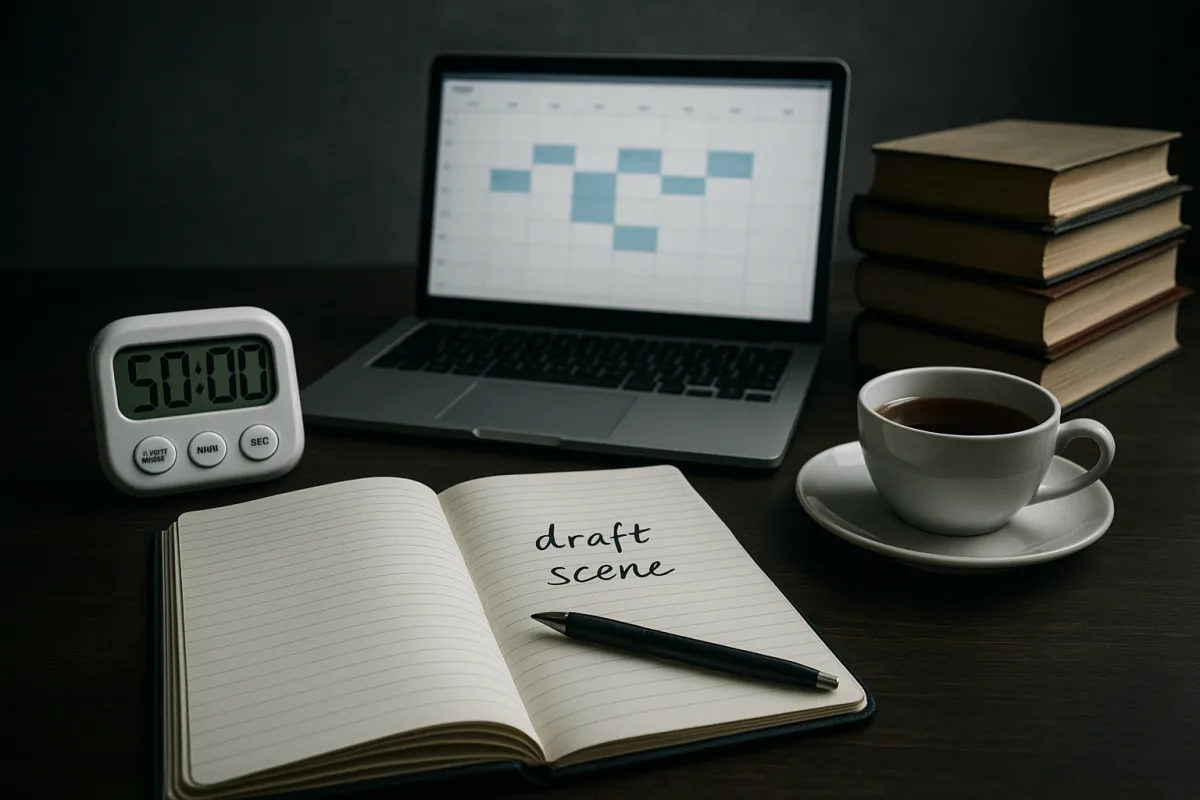
The writing productivity number worth examining: session length
The familiar Pomodoro prescription is 25 minutes of work followed by a five-minute break. It is useful because it makes a vague instruction, “write today”, into an appointment with a visible finish line.
For writers, though, 25 minutes is often mistaken for a law rather than a starting option. The more useful question is not whether Pomodoro works. It is how long a single writing session must be before the work becomes easier.
That distinction matters because writing has a ramp-up cost. You need to reopen the argument, remember the character’s problem, find the right source, or hear the cadence of the previous paragraph. A timer that ends just as this work becomes possible is not necessarily efficient.
Guides comparing interval lengths generally place 25 minutes with routine or low-ramp-up work, 50 minutes with drafting and creative work, and 75 to 90 minutes with uninterrupted, immersive tasks. They also agree that there is no definitive best interval for everybody. [5][6]
That is the system worth keeping: a writing block whose length is chosen for the stage of the work. It is less neat than “four Pomodoros before lunch”, but it asks a writer to match the clock to the actual job.
What a focused writing block actually contains
A usable block has four parts: a defined outcome, a protected period, a stop point, and a short record. The timer is only the second part, and usually the least important one.
Start by naming an outcome that can be finished or honestly assessed. “Work on novel” is too broad. “Draft the confrontation scene”, “turn interview notes into a 700-word news draft”, or “write the first three headings” gives the session an edge.
This is why section completion can be more helpful than a word target. A writer can produce 900 words of evasive throat-clearing, or 250 words that solve the piece’s central problem. Both are words, but they are not equivalent output.
Then protect the block. Close communications, remove the phone, and keep only the material needed for the next outcome available. One review of common workplace mistakes puts the productivity loss from multitasking at roughly 40 percent. The exact figure will vary, but the direction is unsurprising. [17]
At the end, stop and record what happened in one sentence. “Finished argument but need the study’s sample size”, or “Drafted 620 words, next is the transition to costs.” This note is not a productivity ritual. It reduces tomorrow’s re-entry cost.
A break follows the block, not as a reward for virtue but as part of the design. The traditional 25-minute method uses five-minute pauses, while longer sessions need enough time away from the draft to reset before the next task. [5]
Choose 25, 50, or 90 minutes by the work, not your ambitions
Use a 25-minute block when the problem is starting. It suits reading a source, repairing a paragraph, collecting quotations, writing a brief outline, or returning to a document you have avoided.
Its main advantage is psychological and practical. A short block limits the dread attached to an unpleasant task. Its weakness is that it can become a sequence of restarts, particularly for fiction, analysis, or any draft requiring an internal line of thought.
A 50-minute block is the sensible default for most drafting. It gives enough time to reread lightly, write through a bad first few paragraphs, and reach the part where a structure begins to carry its own weight. [5]
Fifty minutes also has a cost. It requires a more definite task and a more believable boundary. If you begin by answering messages, gathering five extra sources, or deciding what the article is about, you can spend the whole interval preparing to write.
Reserve 75 to 90 minutes for work that benefits from staying inside it: a difficult essay section, a chapter, a long feature’s first draft, or structural revision. Guidance on Pomodoro variations describes this range as appropriate for deep, immersive writing when interruptions are unlikely. [5][6]
The cost is recovery and scheduling. A 90-minute block is not simply three 25-minute blocks glued together. It needs a quiet environment, a prepared brief, and a real break afterward. It is difficult to run beside a calendar full of calls.
For that reason, longer sessions tend to work better as planned appointments than as heroic improvisations. A remote worker may protect a morning block before meetings. An office-based writer may use a quieter early period or a room with a closed door.
There is no research-backed universal rule that writers should work at 5 a.m., despite the appeal of that advice. The practical test is simpler: identify the part of your day when interruptions are least likely and your work is least resistant.
Time blocking needs empty space to work
A writing block belongs in a calendar, but not in every available calendar square. Time blocking turns a desired practice into a commitment with a beginning and end. Without buffers, it turns the day into a series of small failures.
Leave space before a block for setup and after it for notes, breaks, research spillover, or an unexpected message that genuinely cannot wait. Rigid schedules that omit breaks are a common route to lower output and burnout, according to the research brief.
For many writers, two to four focused hours a day, across five days, is a more credible sustained workload than trying to write productively from morning to evening. The University of California, Irvine Writing Center recommends that 10 to 20 hour weekly range. [1]
That does not mean four consecutive hours. It might mean two 50-minute drafting blocks in the morning, then one 50-minute revision or research block later. The time between them is part of the system, especially where reporting or reading is involved.
Writers working with distant colleagues have another constraint: asynchronous communication. Guidance for distributed teams recommends clear asynchronous practices across time zones, so the writing block does not require being available in every colleague’s working hour. [13]
Office routines create natural transitions that remote work often lacks. At home, the writer may need to create them deliberately: a start time, a place used only for work, a shutdown note, and an agreement about when messages will be answered. [15][16]
Drafting needs a target, but word counts are not a verdict
A timer says when to stop. A target says what the block is for. Both are needed, but targets should fit the form of writing rather than borrow prestige from a famous author’s routine.
Reported daily targets for novelists range from around 500 words, associated with Ernest Hemingway’s habit, to 2,000 words associated with writers including Stephen King and Brandon Sanderson. The range itself is the useful information: there is no single serious number. [8]
Blog posts can run from roughly 300 to 1,500 words depending on format, while journalism varies from 300 to 800 words for news articles and far more for features. A word target borrowed across those jobs does not measure the same thing. [9]
For a first draft, a modest quota can prevent endless self-correction. For revision, use a completion target instead: verify five citations, cut 300 redundant words, or restructure the first half. Editing does not reliably produce words, but it can produce better work.
Detailed outlining is one of the few commonly cited practices with a specific efficiency claim. Best Word Count says a detailed outline can reduce writing time by 30 to 40 percent. [3] That figure should be treated cautiously, not as a guarantee.
The plausible mechanism is clear even without a definitive study for every kind of writer. Decisions made before the drafting block, such as order, evidence and intended conclusion, do not have to be remade sentence by sentence while the clock runs.
Keep editing out of the drafting block
A common failure mode is calling a session “writing” while repeatedly editing the opening paragraph. The writer is busy, the timer is running, and the draft does not move. This is not a moral flaw. It is two jobs competing for attention.
One approach is to draft in the morning and edit later, a separation recommended in guidance aimed at writers using Pomodoro-style sessions. [22] The gap makes it easier to see what is actually weak, rather than polishing the newest sentence because it is visible.
This separation also clarifies the session length decision. Drafting may deserve 50 minutes. Citation checking or line editing may be better in 25-minute blocks, where a clear checklist can contain work that would otherwise spread across the day.
Use blockers as enforcement, not as a writing method
If the obstacle is a phone or a habitual browser tab, a blocker can make the protected period real. It cannot decide what the next paragraph should say, and it cannot repair an unclear assignment.
Freedom is a cross-platform site and app blocker with a Locked Mode. It costs $8.99 a month or $49 a year, according to the research brief, and suits writers who need blocking to persist across computer and phone.
Forest costs $1.99 as a one-time purchase and uses a gamified focus timer. It suits someone who wants a small external cue to leave the phone alone, rather than a strict cross-device restriction. [10]
Opal is an AI-powered focus and screen-time manager with a deep-focus mode. It suits writers who want to manage phone access in more detail, but the research brief does not provide a price, so readers should check current terms before treating it as a fixed-cost option. [11]
Liven is an anti-procrastination app aimed at perfectionism. It may suit writers whose delay begins with overthinking rather than notifications, though the brief gives no price and does not establish that the app improves writing output. [12]
myNoise provides ambient soundscapes, free with donation options, and may suit people working around unpredictable sound. There is no identified evidence in the brief quantifying its effect on writing output, so it is a comfort preference, not a proven efficiency tool.
Generative AI tools such as ChatGPT and Claude are often used for brainstorming, outlines and rough drafting. A 2026 productivity guide reports efficiency benefits, but there is limited long-term evidence specifically about professional writers’ output or quality. [23]
The sensible boundary is to use such tools where they reduce administrative friction, then verify facts, quotations, reasoning and voice yourself. A faster draft is not necessarily a more reliable one, especially in reporting or expert work.
Finally, do not turn a timer into a diagnosis. If focus, sleep, stress or mood is persistently affecting your ability to work, that is not a writing-efficiency problem to optimise with longer blocks. It is worth discussing with a qualified clinician.
Frequently Asked Questions
What are the best productivity techniques for writers?
Top productivity techniques include time blocking focused on peak mental hours, detailed outlining to reduce writing time, using generative AI tools for drafting and brainstorming, setting clear achievable goals per session, and creating distraction-free environments with app blockers and quiet spaces. Avoiding multitasking is also important, as it can reduce productivity by about 40%.
How long should a writing session be for maximum productivity?
Writing session length depends on the task. Use 25-minute blocks for low-ramp-up tasks like reading or outlining, 50-minute blocks for most drafting and creative work, and 75 to 90-minute blocks for deep, immersive writing requiring uninterrupted focus. The session length should match the complexity of the work and personal attention span.
How can writers structure their writing blocks effectively?
A focused writing block should include a clearly defined outcome (such as completing a scene or section), a protected period free from distractions, a set stop point, and a brief record of progress. Scheduling buffers around writing blocks helps accommodate research and transitions, preventing a packed calendar that can reduce productivity.
What is the ideal Pomodoro interval for writing?
The traditional 25-minute Pomodoro interval suits routine or low-ramp-up tasks, but longer intervals are often better for writing. Fifty minutes is a sensible default for drafting, while 75 to 90 minutes work well for immersive writing requiring sustained focus. Choosing the interval based on the stage and difficulty of the writing task is more effective than a fixed timer.
How can writers avoid burnout while staying productive?
Avoiding burnout involves scheduling buffers around writing blocks to allow for research and transitions rather than packing the calendar tightly. Separating drafting and editing, limiting focused writing to two to four hours a day, and taking real breaks after longer sessions help maintain energy. Managing emotional well-being and stress is also crucial for sustained productivity.
How we researched this
This article was assembled from 23 cited references.
Nothing here is based on hands-on testing. Where a figure or finding appears, it belongs to the source cited beside it, and the writing says so rather than implying otherwise. Every source is listed below so you can check it.
Sources
- The Best Practices for Writing Productivity
- (Re)Committing to a Regular Writing Routine | Writers Workshop | Illinois
- Writing Productivity — 10 Proven Tips to Write Faster & Better
- Best Habits For Highly Productive & Creative Writing | 2026 - Seven Boats
- 25/5, 50/10, or 90 Minutes? Choosing the Right Pomodoro Interval for Your Work
- Best Pomodoro Length: 25, 50, or 90 Minutes? | Ellie
- Pomodoro Timer for Writers: Guide 2025 | LockedIn
- Realistic Daily Word Counts for Writers: Is 2000 a Lot?
- Word Count for Writers: What the Numbers Actually Mean | Very Simple Tools
- The Forest App Will Help You Stay Off Your Phone
- AI Focus Enhancers: Eliminate Distractions in Minutes in 2026 | Top Tools
- Best Anti-Procrastination Apps for Writers (2026)
- Working Across Time Zones: A Remote-Team Playbook | The Global Clock
- Remote Work Productivity Tips That Actually Work in 2026 | spunk.work
- Remote Work Habits: Boundaries and Routines That Work in 2026
- Remote Work Productivity Guide 2026 — Tools, Habits & Setup — remoty.work
- Common Productivity Mistakes at Work (And How to Fix Them)
- The Crucial Role Emotions Play in Productivity
- Focus Techniques: 8 Methods to Build Lasting Concentration
- These Seven To-Do List Mistakes Could Be Derailing Your Productivity
- Pomodoro for Writers: Beating Blank Page Syndrome
- Pomodoro for Writers: Build a Consistent Writing Practice That Actually Works
- Generative AI Productivity: Complete Guide to AI Productivity Tools 2026
Related Articles
Structured Focus Intervals
Learn how structured focus intervals like the Pomodoro technique improve productivity with timed work and breaks for better concentration.
How to Measure Productivity Effectively
Learn how to measure productivity effectively using progress, quality, and time tracking for meaningful insights into your work.
How to Use Affirmations for Productivity Effectively
Learn how to use affirmations for productivity with believable, task-specific statements that boost focus and help you start work.

Visualization for Productivity
Learn how to use visualization for productivity with process-focused mental rehearsal to boost motivation and prepare for work tasks effectively.