
52 17 Productivity Technique for Remote Work Focus Cycles
Learn the 52 17 productivity technique for remote work: focus blocks and breaks that boost deep work and reduce distractions effectively.
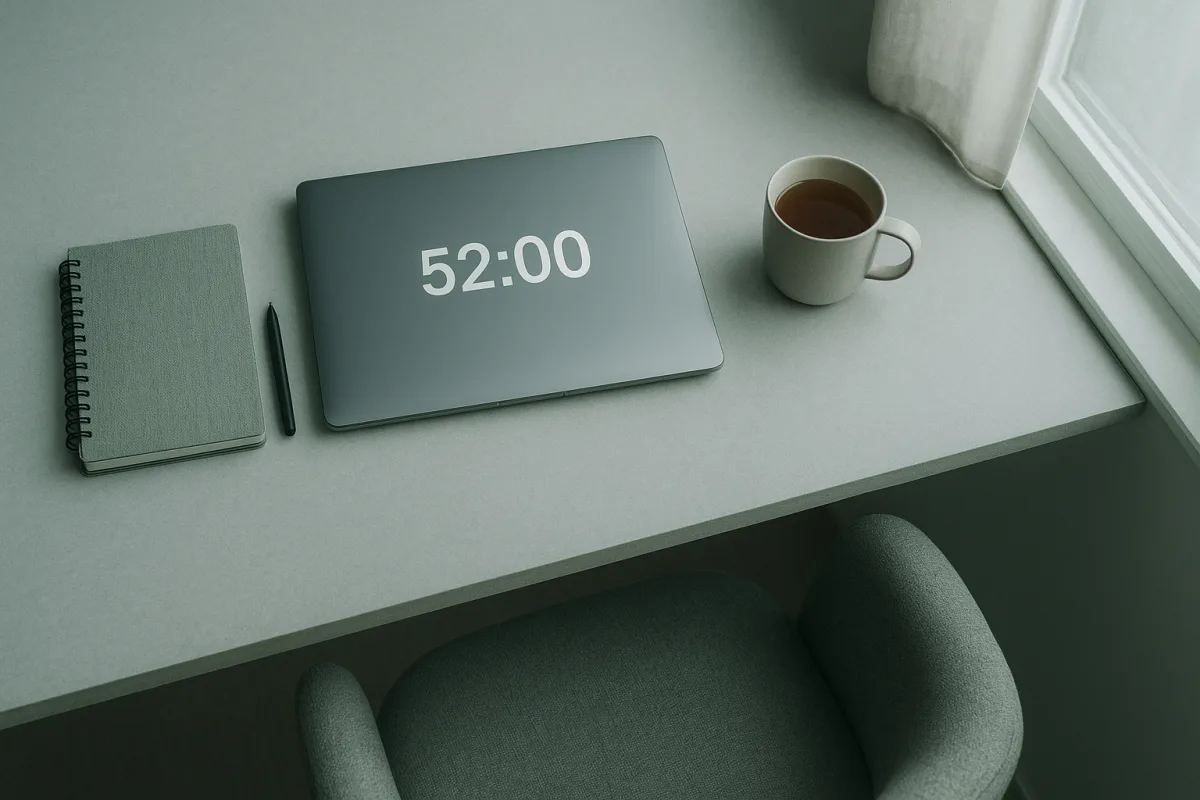
The remote-work technique worth understanding is a cycle, not a longer day
The most useful remote-work technique is not a particular app, desk accessory or heroic morning routine. It is a protected cycle of focused work and genuine time away from the work, commonly expressed as 52 minutes on and 17 minutes off. [6]
That number is often repeated as though it were a discovered law of attention. It is better understood as a practical pattern drawn from activity data, one that gives remote workers a clear answer to an otherwise slippery question: when, exactly, do you stop?
Working from home removes several external stopping points. Nobody walks past to ask whether you want coffee. A meeting room is not needed by another group. Email and chat remain open beside the document that requires thought.
The result is often not sustained concentration. It is continuous partial attention, with a little work, a little Slack, a little household administration and a little anxious checking of the inbox. A timer cannot remove those demands, but it can sort them.
What 52/17 asks of you each day
A 52/17 cycle has two parts. For 52 minutes, choose one defined piece of work and remove the usual routes into interruption. For 17 minutes, stop working rather than merely changing tabs.
The work portion needs a concrete target. “Work on the proposal” is too vague. “Draft the opening, select three supporting figures and send the draft for review” is better because it creates a visible stopping point.
During that block, close the chat app, silence notifications and keep email out of sight. Scheduled email checks and device focus modes are among the boundary measures recommended for reducing distraction in home working. [3][4]
The break portion is not spare time to catch up on messages. If the break becomes a quick reply to a colleague, followed by another reply and then a meeting request, it is simply a second kind of work.
A useful break is deliberately low stakes: stand up, make a drink, step outside, stretch, put laundry in the machine or look away from the screen. The point is a change in task and posture, not an optimised wellness ritual.
The evidence base supports breaks more confidently than it supports any single magic interval. Research summarised in the Journal of Applied Behavior Analysis found that short, frequent breaks can improve task completion and wellbeing. [1]
The 52-minute work period and 17-minute break are therefore a sensible experiment, not a prescription. The brief’s cited Draugiem Group data suggests that pattern, while other remote-work guidance recommends much longer two-to-four-hour deep-work blocks. [3][6]
Those recommendations are not necessarily in conflict. A writer editing a difficult report may need several cycles aimed at the same project. The meaningful unit is not one 52-minute block, but a morning or afternoon with enough blocks protected for substantial work.
The arithmetic is the part people skip
The cost of the system is visible. Every 52 minutes of focused work comes with 17 minutes away, meaning a full cycle occupies 69 minutes of the calendar. About one quarter of that scheduled period is break time.
Six cycles contain 312 minutes, or 5 hours 12 minutes, of focused work. They also contain 102 minutes, or 1 hour 42 minutes, of breaks. Together they fill 6 hours 54 minutes, leaving little room in a nominal workday for meetings, lunch or administration.
That is not a flaw. It is the reality check. A calendar containing five hours of demanding individual work, four meetings and instant chat availability is not a productivity plan. It is competing expectations written in different colours.
Most people will not need six cycles. Two morning cycles may be enough for a role dominated by collaboration. Four may fit someone whose job involves analysis, writing, design or technical work, provided their organisation protects that time.
The system becomes harmful when it turns into another quota. Completing fewer blocks on a day with a difficult client call, a sick child or an urgent operational problem does not show a lack of discipline. It shows that work changed.
Put shallow work somewhere else
The 52/17 cycle works only when shallow work has a home elsewhere in the day. Shallow work includes sorting email, updating a project board, filing documents, checking routine requests and responding to ordinary chat messages.
NexaSphere’s remote-work guidance recommends time blocking structured periods for deep and shallow work, alongside asynchronous communication to cut meeting overload. [3] The important mechanism is not the labels. It is deciding beforehand which kinds of work can interrupt which others.
A simple day might begin with two focus cycles before checking email. It might then have a 30-minute communications window, a meeting period, and one later focus cycle for the task that survived the morning’s new information.
This arrangement will feel uncomfortable for people accustomed to instant replies. That discomfort is useful information. If a job genuinely requires immediate response, it may not be suitable for long protected blocks, at least not without shared coverage.
Asynchronous communication is often presented as an automatic cure for remote-work overload. It can reduce unnecessary meetings and let people respond when they are no longer in the middle of difficult work. [3]
But it requires organisational habits, not just a written preference. Colleagues need to state urgency clearly, document decisions and accept that an ordinary question may wait. Teams without those norms can experience asynchronous work as silence and uncertainty. [12]
For a manager, this means the technique involves more than personal timer use. Someone must make availability expectations explicit, protect focus periods in calendars and establish what counts as an urgent interruption.
The home setup matters, but it does not need to be expensive
A dedicated workspace makes the transition into a focus block easier because it supplies a physical cue: this is where work happens. Guidance on remote work consistently links separate work areas and digital boundaries with fewer distractions. [3][4]
“Dedicated” does not have to mean a spare room. It can be one end of a kitchen table that is cleared before and after work, headphones that are worn only during a focus block, or a laptop put away outside defined hours.
The important part is the transition at both ends. Starting work at the same place and time reduces the negotiation involved in beginning. Leaving that space or packing equipment away makes it easier to stop reopening work later.
That matters especially for workers with children at home. Axios recommends structured routines and practical coordination when home working overlaps with remote learning or childcare. [2] A perfect 52-minute block may simply not be available on some days.
In that situation, shorten the commitment without pretending the interruption does not exist. One 25-minute block may be more realistic than repeatedly failing to protect 52. The underlying technique is planned attention and planned recovery, not loyalty to a number.
Time zones create a related constraint. Distributed teams commonly need a shared overlap period, with guidance suggesting three to four hours for collaboration. [12][13] Put meetings and fast decisions there where possible, then reserve local non-overlap time for focused work.
There is little evidence for elaborate productivity systems tailored to particular cities or countries. Seasonal light exposure and time zones can affect schedules, but the brief found no basis for detailed geographic customisation beyond those factors.
Tools can support the cycle, but they cannot create permission
A timer, calendar and communication setting are sufficient to run 52/17. The productivity software market offers more capable options, but the research brief found no direct cost-benefit studies connecting tool spending to improved worker outcomes.
For planning blocks and tasks, Notion’s team plan is listed at $10 per month, Obsidian Sync at $25, and Todoist Pro at $4 per month. [14][15] Notion suits shared documentation, Obsidian suits personal notes, and Todoist suits straightforward task lists.
For communication, Slack Pro is listed at $7.25 per user per month, Loom Business at $12.50, Zoom Pro at $13.33 and Otter.ai Pro at $10. [14][15] Slack suits team messaging, Loom recorded updates, Zoom live meetings and Otter.ai meeting transcription.
Those are subscription prices, not the cost of implementing a system. They do not include staff time spent migrating information, agreeing conventions, training colleagues or maintaining yet another place where work can be hidden.
All of those services have free tiers, according to the app roundups. [14][15] Start there if a tool is needed at all. A calendar block titled “analysis, do not interrupt” is more valuable than an expensive workspace nobody checks.
Who should not force this system
The cycle is poorly suited to roles requiring continuous real-time monitoring, such as frontline support, live operations or jobs where a colleague must answer immediately for safety or service reasons. Those roles need coverage design, not notification guilt.
It is also a poor fit for work already fragmented into very short, externally assigned tasks. A person processing a constant queue may get more value from grouped handling windows than from trying to defend a 52-minute block that cannot survive contact with reality.
People who find a 17-minute pause too long can try shorter breaks. The evidence supports frequent breaks generally, and the ideal interval varies by person and task. [1][6] The test is whether the return to work is easier, not whether the timer was obeyed.
Mindfulness is sometimes added to break advice, usually as a way to reduce stress or steady attention. There is evidence for workplace mindfulness practices in stress-related outcomes, but direct evidence that it measurably improves remote-work productivity is less robust. [5]
That makes mindfulness an optional practice, not a required component of efficient home working. A quiet walk, lunch away from the laptop or ten minutes doing nothing productive may serve the same boundary function without becoming another performance metric.
Finally, do not use work cycles to paper over health problems. If concentration is persistently difficult, sleep is poor, or mood has shifted, changing break length may be beside the point. A doctor or qualified clinician is better placed to assess that than a productivity system.
Frequently Asked Questions
What is the 52 17 productivity technique for remote work?
The 52 17 technique is a cycle of 52 minutes of focused work followed by a 17-minute break. During the work period, distractions like chat, email, and notifications are removed, and a concrete task is targeted. The break is meant for genuine rest away from work tasks, such as stretching or stepping outside, rather than quick replies or meetings.
How do I schedule breaks and focus time when working remotely?
Schedule focused work blocks with clear, concrete goals and protect them from interruptions by closing chat apps and silencing notifications. Plan breaks as real downtime, avoiding work-related activities during these periods. Time blocking deep work separately from shallow work like email and meetings helps maintain focus and efficiency.
Why is the 52 17 cycle effective for remote work productivity?
This cycle provides a practical stopping point in an environment lacking natural breaks, helping to avoid continuous partial attention. Research shows short, frequent breaks improve task completion and wellbeing. The 52/17 pattern is a sensible experiment based on activity data, balancing sustained focus with recovery time.
How can I separate deep work and shallow work in a remote job?
Deep work should be scheduled into protected focus blocks with distractions minimized, while shallow work such as email, chat, and routine tasks should be allocated to separate, deliberately scheduled windows. This separation prevents shallow work from fragmenting focus time and helps manage competing demands effectively.
What are practical ways to protect focus time when working from home?
Close chat applications, silence notifications, and keep email out of sight during focus blocks. Use device focus modes and scheduled email checks as boundary measures. Having a dedicated workspace and clearly defined work periods also helps reduce distractions and maintain concentration.
How we researched this
This article was assembled from 21 cited references.
Nothing here is based on hands-on testing. Where a figure or finding appears, it belongs to the source cited beside it, and the writing says so rather than implying otherwise. Every source is listed below so you can check it.
Sources
- Breaks and productivity: An exploratory analysis.
- 5 tips for balancing your work-from-home schedule while facilitating remote learning for your child
- 15 Remote Work Productivity Tips That Actually Work in 2026 | NexaSphere
- 11 Productivity Tips That Actually Work in 2026 | H2Home Blog | H2Home
- Mindfulness at Work: Evidence-Based Practices for a Stressful Workplace (2026) | Simply Psychology
- Remote Work Microbreak Statistics 2026 | Stealth Agents
- Your Exercise Routine for Sharper Focus Starts Here
- Age-Appropriate WFH Fitness: Every Life Stage
- Best Micro-Break Strategies for Sustained Focus | Neurosity
- Why Light Activity Breaks Improve Focus and Energy
- Remote Work Guide: Essential Techniques for Productivity and Success - SOS Events
- Remote Work Strategy: How Organizations Design Distributed Work Models That Maintain Productivity, Culture, and Competitive Advantage | Stratrix
- Best Time Zones for Remote Teams — Overlap, Productivity & Examples
- 10 Best Productivity Apps for Remote Workers in 2026
- Best Productivity Apps for Remote Workers 2026: Tested and Ranked | Productivity Works
- Best Productivity Apps for Remote Workers 2026: Ranked
- 11 Remote Work Behaviors That Blur Boundaries and Increase Burnout | The WiC Project Blog
- Setting Boundaries: How to Separate Personal Life from Remote Work
- 10 Common Remote Work Mistakes- Ways To Fix Them
- Achieve Work-Life Balance - Remote Work Setup
- Boundary Setting for Remote Workers: Complete Guide to Work-Life Balance
Related Articles
Structured Focus Intervals
Learn how structured focus intervals like the Pomodoro technique improve productivity with timed work and breaks for better concentration.
Productivity Podcasts by Format and Focus: Find Your Fit
Discover productivity podcasts by format and focus, from short daily tips to deep work and science-based shows tailored to your needs.

Master Shaw Hungi: Overcoming Hindrances and Finding Purpose
Master Shaw Hungi, a renowned monk, shares insights on overcoming hindrances and finding purpose in a chaotic world. Emphasizing self-reflection, balance, and connection to a universal source, he offers wisdom on mental well-being and living authentically.

Jordan Peterson's Wisdom on Love, Conflict, and Identity in Modern Relationships
Delve into the complexities of modern relationships and the wisdom of Jordan Peterson on love, conflict, and identity in this enlightening episode of The Diary Of A CEO. Explore the impact of pre-marriage cohabitation, the importance of embracing challenges, and the interconnected nature of emotions and social connections. Peterson's insights on sacrificial relationships and the pursuit of higher goals offer a roadmap to navigating the chaos of life.