Productivity Podcasts by Format and Focus: Find Your Fit
Discover productivity podcasts by format and focus, from short daily tips to deep work and science-based shows tailored to your needs.
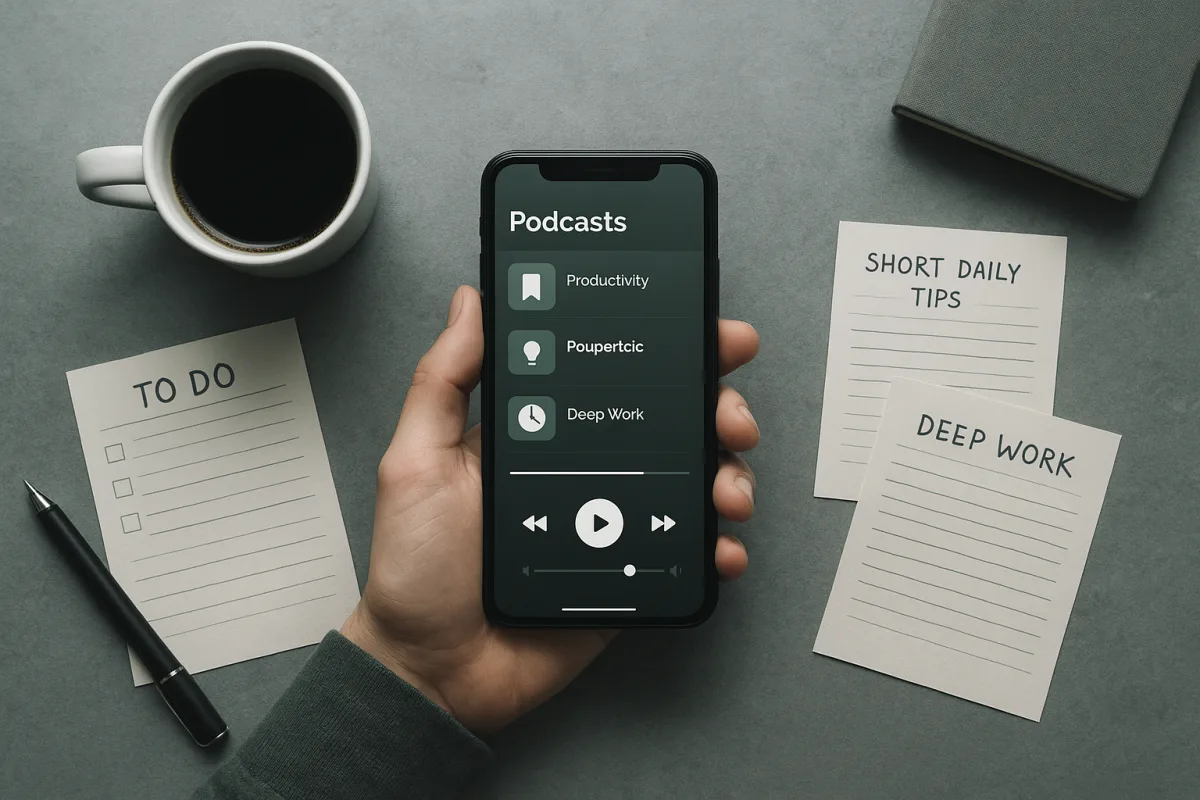
The quick list
- Best overall: The Productivity Show by Asian Efficiency, for listeners who want practical systems and tools rather than inspirational stories. [5]
- Best value: Before Breakfast by Laura Vanderkam, for busy people who can realistically use a five-minute weekday prompt. [5]
- Best for deep work: Deep Questions with Cal Newport, for knowledge workers who want considered answers about focus and intentional work. [13]
- Best science-led option: Huberman Lab by Dr. Andrew Huberman, for listeners interested in research-oriented discussions of focus and performance, with appropriate caution around health claims. [10]
- Best for long interviews: The Tim Ferriss Show, for people who enjoy extracting ideas from detailed conversations with high performers. [5]
- Best for workplace psychology: WorkLife with Adam Grant, for people trying to understand the social and psychological side of work. [5]
- Best for everyday priorities: The Lazy Genius Podcast, for listeners who want help deciding what deserves effort and what does not. [13]
- Best for sustainable pace: Hurry Slowly by Jocelyn K. Glei, for people drawn to focus and lower-stress ways of working. [5]
- Best for creative work: The Accidental Creative by Todd Henry, for creative professionals looking for work-and-life advice suited to their field. [5]
- Best for habits: Happier with Gretchen Rubin, for listeners interested in behaviour change and conversations about habits. [5]
- Best for better decisions: The Knowledge Project by Shane Parrish, for people who want interviews centred on mental models and decision-making. [7]
What you are actually choosing
The useful question is not which podcast is “the best.” It is what you need audio to do during an ordinary week, when you have limited attention and little appetite for turning every commute into homework.
Some shows provide a small prompt you can try before lunch. Others offer a framework that may take an hour to understand, then longer to adapt. Neither format is superior, but they solve different problems.
The labels below, entry-level, mid-range, and premium, describe the field supplied for this comparison. They are not published subscription prices, and no current price figures are included here.
That distinction matters because paid tiers are appearing across podcasting, but they are not standard in productivity audio and there is no consolidated pricing data for this category. A higher field tier should not be mistaken for paid access or better evidence.
There is also no public, comparable set of downloads, listener ratings, or completion rates for these programmes in 2026. Services publish charts and recommendations, but they do not provide enough transparent data to settle a definitive ranking. [2]
Comparison table
| Podcast | Field tier, not a price | Typical listening layout | Core subject | What it asks of you | Main trade-off | Best suited to |
|---|---|---|---|---|---|---|
| Before Breakfast by Laura Vanderkam | Entry-level | One short weekday idea, roughly five minutes | Time use and practical productivity | Notice one useful idea and try it | Can feel too brief for complex work problems | Busy people needing a small prompt |
| The Lazy Genius Podcast | Entry-level | Practical advice format | Priorities in everyday life | Decide what matters before optimising it | Less specialised for formal workplace systems | People overwhelmed by competing life tasks |
| The Productivity Show by Asian Efficiency | Mid-range | Systems and tools | Workflows and productivity practices | Adapt a method to your own tools and calendar | Can encourage collecting systems instead of using one | Listeners building a practical operating system |
| WorkLife with Adam Grant | Mid-range | Workplace psychology exploration | Work, teams, and motivation | Reflect on the work environment, not only personal habits | Not a step-by-step task-management show | People interested in how work functions |
| Hurry Slowly by Jocelyn K. Glei | Mid-range | Focus and sustainable-work discussions | Focus and stress | Reconsider pace and definitions of productive work | Less useful for someone seeking a rigid tool setup | Listeners concerned with sustainable work |
| The Accidental Creative by Todd Henry | Mid-range | Advice for creative professionals | Creative work and professional life | Apply ideas to a creative practice | Narrower fit outside creative roles | Designers, writers, and other creatives |
| Happier with Gretchen Rubin | Mid-range | Habit and behaviour conversations | Happiness and habits | Experiment with behaviour change ideas | Broader lifestyle framing may not suit work-only listeners | Habit-focused listeners |
| Deep Questions with Cal Newport | Premium | Listener-question, principles-led discussion | Focus, deep work, intentional living | Think through work constraints and make larger changes | Not designed as a quick-fix feed | Knowledge workers seeking depth |
| Huberman Lab by Dr. Andrew Huberman | Premium | Long, science-oriented protocols and discussion | Focus, sleep, and performance | Evaluate evidence and separate advice from medical care | Health-adjacent claims require care and context | Listeners interested in science framing |
| The Tim Ferriss Show | Premium | Long-form interviews | Routines, habits, and performance | Extract relevant ideas from varied guests | Length and guest variation demand selectivity | People who enjoy detailed interviews |
| The Knowledge Project by Shane Parrish | Premium | Interviews with leading thinkers | Mental models and decisions | Translate abstract thinking into decisions | Less directly about calendars or task lists | Listeners interested in judgment and reasoning |
The best podcasts by listening problem
If your problem is that you have no spare time
Before Breakfast by Laura Vanderkam is the strongest match. Lifestack describes it as one practical piece of advice per episode, released five days a week, with episodes around five minutes long. [5]
That layout is unusually clear about its daily demand. You can listen while making coffee, walking between meetings, or opening your laptop, then decide whether the idea deserves a trial.
The trade-off is equally clear. A five-minute episode cannot diagnose why a team’s workload is unmanageable, why a role lacks boundaries, or why a project is stuck. It is a prompt, not a complete system.
The Lazy Genius Podcast is also entry-level, but it solves a different problem. Oku describes its premise as being a genius about what matters and lazy about what does not. [13]
That is useful for someone whose “productivity” problem is really indiscriminate effort. It is less useful if you already know your priorities and need a concrete way to manage projects, tasks, or information.
If you want a system, not another motivating idea
The Productivity Show by Asian Efficiency is the best overall option for listeners seeking practical systems and tools. Its stated focus is improving productivity through systems and tools, rather than simply profiling successful people. [5]
This is the category to choose when the recurring issue is workflow: tasks disappear across apps, planning happens only when deadlines hurt, or useful routines never make it beyond a notebook.
The danger with systems content is familiar. You can spend weeks comparing tools, labels, and frameworks without doing the boring part, which is maintaining one list and reviewing it consistently.
Deep Questions with Cal Newport sits at the premium end of this comparison because it takes a more conceptual route. Cal Newport, author of Deep Work, answers listener questions about focus, time management, and living intentionally amid distraction. [13]
This is better for someone whose work requires concentration and whose problem cannot be fixed by a new template. It asks you to examine workload, communication habits, and the conditions that make focused work possible.
It is not well suited to someone wanting a five-minute tactic before a meeting. Principles need interpretation, and the show’s value depends on whether you are willing to adapt them to your actual job.
If you want work to make more sense
WorkLife with Adam Grant is the better choice when your questions involve colleagues, culture, motivation, or the design of work itself. Lifestack characterises the show as an exploration of the science of work. [5]
That broader lens is valuable because not every productivity problem belongs to one individual. Poorly designed processes, unclear authority, and constant interruption are organisational problems, not failures of personal discipline.
Hurry Slowly by Jocelyn K. Glei has a related but more individual emphasis. It explores working and living with more focus and less stress, making it a useful alternative for listeners questioning whether faster is always better. [5]
Neither show is a conventional task-management course. Choose them when you need perspective on how work feels and functions, not when you need a detailed method for processing an inbox tonight.
For creative professionals, The Accidental Creative by Todd Henry is more specific. It offers advice intended to help creative people thrive in work and life. [5]
That specificity is its advantage and limit. A writer, designer, producer, or strategist may find the framing more relevant than generic productivity advice, while someone managing operational work may need a more systems-oriented show.
If habits, decisions, or performance are the attraction
Happier with Gretchen Rubin is the mid-range choice for habit-minded listeners. Gretchen Rubin discusses happiness and good habits with her sister Elizabeth Craft, according to Lifestack. [5]
Its fit depends on whether you find behaviour change intrinsically interesting. If you want to understand the patterns behind routines, it may be useful. If you only need a reliable project-planning practice, it is probably too broad.
The Knowledge Project by Shane Parrish is premium in the supplied field and takes an even less direct route to productivity. It uses interviews with leading thinkers to explore mental models for better decision-making. [7]
This is the option for people who think better choices upstream would improve their work downstream. Its limitation is that mental models do not automatically become a weekly plan, meeting agenda, or task list.
The Tim Ferriss Show also belongs in the premium group, but its format is long-form interviews with high performers about routines, habits, and productivity systems. [5]
Long interviews can yield useful detail, especially when a guest explains the context behind a routine. They can also produce a pile of borrowed habits that made sense for somebody else’s resources and responsibilities.
Use it selectively rather than treating every guest’s routine as a template. The most transferable material is usually the reasoning behind a practice, not the exact wake-up time, diet, schedule, or equipment.
A note on science and health-adjacent advice
Huberman Lab by Dr. Andrew Huberman is the premium option for listeners attracted to science-based discussions of focus, sleep, and peak performance. Boredom at Work describes it as providing science-backed protocols in these areas. [10]
The appeal is understandable. Productivity advice often lacks a mechanism, while scientific explanations can help listeners ask more precise questions about attention, learning, recovery, and environment.
But productivity podcasts are not a substitute for medical assessment. Sleep disruption, persistent low mood, severe anxiety, or difficulty concentrating can have many causes, and none should be reduced to a routine problem.
That does not make the show unsuitable. It means listeners should keep a firm boundary between general education and personal health advice, especially when changing behaviour could interact with medication, illness, or treatment.
How to listen without creating another backlog
Pick one show based on your current problem, then set a narrow listening rule. For example: one Before Breakfast episode each weekday, one Deep Questions episode during a weekly walk, or one interview only after finishing the previous notes.
Do not subscribe to all eleven just because they are useful in different ways. The result is usually an overflowing feed and the feeling that other people’s systems have become another obligation.
A simple filter works better: after an episode, write down one idea, one situation where it might apply, and the smallest next action. If no next action appears, let the episode remain interesting rather than actionable.
There is little evidence that a particular publishing frequency or episode length makes a productivity podcast effective for every listener. General podcast release patterns do not tell you whether a specific format fits your workday.
Audio quality and a dependable publishing schedule matter, but suitability matters more. Common selection mistakes include choosing generic titles, ignoring the format, and expecting quick fixes rather than defining a clear need first. [8]
Who each option suits
Before Breakfast by Laura Vanderkam suits busy listeners who want a brief weekday cue and can act on one small idea. It does not suit someone seeking a complete productivity system.
The Lazy Genius Podcast suits people who need permission and criteria to prioritise. It is less suited to listeners looking for specialised workplace methods or technical planning tools.
The Productivity Show by Asian Efficiency suits people ready to build and maintain practical systems. It does not suit someone who is prone to endlessly changing apps, methods, and workflows.
WorkLife with Adam Grant suits listeners interested in workplace psychology and organisational dynamics. It is not the obvious first choice for a narrowly tactical personal-planning problem.
Hurry Slowly by Jocelyn K. Glei suits people seeking a more sustainable relationship with focus and work pace. It may not satisfy listeners who want direct instructions and quick implementation.
The Accidental Creative by Todd Henry suits creative professionals who want advice shaped around creative work. It is less targeted for roles dominated by operations, administration, or technical task management.
Happier with Gretchen Rubin suits listeners who enjoy thinking about habits and behaviour patterns. It is a weaker fit for someone whose primary need is project execution.
Deep Questions with Cal Newport suits knowledge workers prepared to think carefully about attention, workload, and work design. It is not ideal for listeners who only have a few minutes.
Huberman Lab by Dr. Andrew Huberman suits listeners who want a scientific frame for questions about performance and focus. It does not replace individual medical advice on sleep, mood, or concentration.
The Tim Ferriss Show suits people who like lengthy interviews and can separate transferable principles from a guest’s personal circumstances. It will frustrate listeners who want a concise, repeatable format.
The Knowledge Project by Shane Parrish suits listeners interested in better judgment, reasoning, and decisions. It is less suitable for anyone who needs immediate help with daily task capture or scheduling.
Frequently Asked Questions
Which productivity podcasts are best for short daily episodes?
Before Breakfast by Laura Vanderkam is the clearest fit for short daily episodes, offering roughly five-minute practical ideas on weekdays. It suits busy people who want a small prompt without a large time commitment.
What productivity podcasts offer deep work and focus advice?
Deep Questions with Cal Newport is recommended for knowledge workers seeking considered answers about focus and intentional work. It provides deeper reflection on principles rather than quick hacks.
How to choose a productivity podcast based on format and content?
Select a podcast according to the kind of friction you face: brief prompts for busy days, systems-focused shows for workflow changes, or long interviews and principle-led shows for deeper reflection. Format and subject matter are more useful criteria than popularity rankings.
Are there science-led productivity podcasts worth listening to?
Huberman Lab by Dr. Andrew Huberman offers research-oriented discussions on focus and performance. Listeners should treat health and optimization claims cautiously and consult qualified clinicians for persistent difficulties.
What productivity podcasts suit busy people with limited time?
Before Breakfast is best suited for busy people needing a small, actionable prompt in about five minutes. It delivers practical time-use ideas that fit into tight routines without requiring long listening sessions.
How we researched this
This article was assembled from 13 cited references.
Nothing here is based on hands-on testing. Where a figure or finding appears, it belongs to the source cited beside it, and the writing says so rather than implying otherwise. Every source is listed below so you can check it.
Sources
- 12 Best Motivational Podcasts to Fuel Ambition and Inspire Growth
- Best Self Improvement Podcasts 2026: Top 20 by Data | CastFox
- 10 Explore the best of NPR podcasts in 2025 | Resonate Recordings
- Top 10 Productivity Podcasts to Follow in 2026
- Best Productivity Podcasts of 2026 | Lifestack
- Tim Stringer - Guest Posts, Podcasts & Videos — Technically Simple
- Best Productivity Podcasts (2026) | PodBrief
- Podcast Launch Mistakes: Why New Podcasts Fail in the First 30 Days
- Is AI Going to Turn Us All Into Middle Managers?
- Huberman Lab by Dr. Andrew Huberman
- The Great Awakening Map with 5D Awakening Consciousness Creator, Champ Parinya | Reclaiming Consciousness Episode on Amazon Music
- Huberman Lab - Podcast - Apple Podcasts
- Best productivity podcasts in 2026 | Oku
Related Articles
52 17 Productivity Technique for Remote Work Focus Cycles
Learn the 52 17 productivity technique for remote work: focus blocks and breaks that boost deep work and reduce distractions effectively.
Best Productivity Podcasts
Explore the best productivity podcasts with detailed comparisons to help you choose the right show for focus and workflow systems.
Structured Focus Intervals
Learn how structured focus intervals like the Pomodoro technique improve productivity with timed work and breaks for better concentration.
Best Productivity Books by Problem Type
Discover the best productivity books tailored to your problem—habits, focus, or managing work—to help you choose the right read for your needs.