
Visualization for Productivity
Learn how to use visualization for productivity with process-focused mental rehearsal to boost motivation and prepare for work tasks effectively.

Start by lowering the claim
Visualization is easy to oversell because it feels productive. You close your eyes, picture yourself working well, and emerge with a clean internal story about the day. That may help you begin, but it is not the same as having done the work.
The useful claim is narrower. Mental rehearsal appears to activate some neural pathways that overlap with actual task performance, sometimes called functional equivalence. That makes it plausible as preparation for a known action, particularly one you find yourself avoiding or fumbling. [1]
The less useful claim is that visualization will reliably make you more productive. Research has not established direct improvements in task completion, sustained attention, or output for non-athlete workers. Much of the evidence people cite comes from sport, or from training people to interpret data visualizations faster.
That distinction matters when you choose a use for it. Do not add a daily mental exercise because you want to become a more disciplined person. Use it when you need to reduce uncertainty about a specific piece of work.
The first problem: picturing success instead of work
Most people begin with outcome visualization. They picture an empty inbox, a submitted report, a successful presentation, or the relief of being caught up. It is understandable, because results are easier to imagine than the inconvenient middle.
The problem is that a satisfying end-state can reduce urgency. Simply Psychology’s overview notes that imagining desired outcomes may increase motivation in some circumstances, but can also lower the pressure to act because the mind has already sampled the reward. [1]
A 2026 study published in Current Psychology points in a more practical direction: process-oriented thinking, focused on the actions required, was more helpful for motivation and goal pursuit than fixation on an end result. [9] For productivity, that means rehearsing the work sequence.
Before a proposal, do not picture the client approving it. Picture opening the brief, writing the one-sentence problem statement, finding the previous proposal, drafting three headings, and sending a rough version for review. The point is not to make the future impressive. It is to make the next twenty minutes familiar.
This is one of the two versions of visualization that tends to survive a real week: a brief rehearsal before a task with a clear starting action. It asks little of you, and it has a direct handoff into actual work.
Build a scene small enough to rehearse
Vague imagery is one of the common ways visualization becomes decorative. “I will focus this afternoon” gives your mind almost nothing to work with. A useful scene has a location, a tool, a first action, an obstacle, and a response. [6]
Write a short prompt before you close your eyes. For example: “At 9:15, I sit at the desk, open the quarterly spreadsheet, filter for overdue invoices, and write the first three follow-up emails. When I want to check messages, I write the urge on paper and return to email number one.”
That prompt is deliberately unglamorous. It includes the interruption because real work includes interruptions. Rehearsing a frictionless scene can leave you stranded at the first predictable snag, such as an unclear file name, a slow system, or the urge to switch tasks.
Keep the scene to one work block and one obstacle. Overcomplication, inconsistency, insufficient specificity, and failure to review the image are all identified as problems that reduce the usefulness of visualization exercises. [6] You are making a cue for action, not directing a feature film.
Use first-person, sensory rehearsal
There is a meaningful difference between watching yourself work as if you were in a film and imagining work through your own eyes. First-person perspective and multi-sensory detail are associated with more effective mental rehearsal. [1][2]
In practice, see the document cursor blinking where you expect it to be. Feel your hands open the laptop or pick up the notebook. Hear the notification-free room, or the familiar background noise of the place where you will work. Include the bodily feeling of beginning before you feel fully ready.
You do not need vivid mental pictures to do this well. Some people do not naturally form clear visual images. In that case, use language, spatial awareness, touch, sound, or sequence: “open file, read first paragraph, type one bad sentence, check source folder.”
This is the second version that holds up under ordinary constraints: a written, first-person action script read slowly before work. It uses the same process focus without requiring cinematic imagery. The research supports multi-sensory rehearsal, not a particular level of visual talent. [1][2]
Put it immediately before a task
Timing advice online often becomes needlessly exact. Sources on visualization routines suggest morning, midday, and early evening as workable windows, with a recommendation to avoid practicing within two hours of bedtime. [4][5]
Those windows are less important than proximity to the task. A ten-minute rehearsal at 7:30 is unlikely to help much with a difficult call at 3:00 unless you repeat the relevant sequence shortly before the call. Use the suggested times as scheduling options, not biological law.
Morning visualization can suit planning work because you can rehearse the day’s first substantial block before messages take over. Midday can suit a reset before a meeting, a writing session, or the task you postponed in the morning. [4][5]
Early evening may be useful for rehearsing tomorrow’s first step, especially if you tend to waste the first part of the next day deciding where to begin. Do not treat it as a sleep intervention. If sleep is disrupted, discuss it with a clinician rather than adding more self-optimisation.
The practical sequence is simple: review your task prompt, rehearse the steps for a few minutes, remove one obvious distraction, then start the first action before opening anything unrelated. Visualization without that immediate transition can become another way to postpone beginning.
Keep the dose modest
The most specific duration guidance in the brief comes from a 2025 meta-analysis of 24 randomized controlled trials involving 1,294 athletes. It found an apparent sweet spot of roughly 10 to 15 minutes, around three times weekly, with diminishing returns from daily practice. [3]
That is useful as a starting experiment, not a prescription. Athletes rehearse performance differently from people preparing a budget, analysing research, or writing a difficult email. We do not have strong evidence that the same duration or frequency improves workplace output.
Begin with three sessions per week for two weeks. Use them only before tasks where you can identify a concrete sequence: a presentation, a report outline, an administrative batch, a technical procedure, or a conversation you are avoiding.
If ten minutes makes you restless, shorten the rehearsal rather than quitting the practice. The evidence does not say that five minutes is useless, only that the clearest duration finding comes from a different population and should not be stretched beyond what it shows. [3]
Regularity may matter more than intensity. The same research summary suggests that sustained mental-health benefits appeared over roughly 14 weeks of practice. [3] That is not evidence that visualization treats mental-health conditions, and it should not be used that way.
Check whether it is helping the work, not the feeling
A good visualization session can feel calming, organised, or motivating. Those are not useless effects, but they are not proof that the system is earning its place. The available research does not give you a reliable productivity metric to borrow.
Use a small before-and-after record for four weeks. For each rehearsal, note the task, your planned first action, whether you began within ten minutes, and whether you completed the planned work block. This is not a clinical trial. It is a way to notice whether the routine changes behaviour.
Also note when the exercise backfires. If you finish rehearsing with a warm sense of having already achieved something, that is a sign to reduce outcome imagery and make the process script more concrete. The risk is consistent with the caution around end-state visualization. [1]
Do not use this log to judge yourself for missing sessions. A missed rehearsal tells you mainly that the routine did not fit that day. The useful question is whether it was too long, too vague, too detached from the task, or scheduled at a time when you could not act afterwards.
Adapt the imagery to how you naturally think
Visualization is not culturally or cognitively neutral. Research on cross-cultural visual processing has found differences in emphasis, with more holistic processing often reported in Eastern contexts and more analytical processing often reported in Western contexts. [10]
That does not mean assigning yourself a style based on nationality. It means avoiding the assumption that a single visualisation template, usually a highly individual picture of success, will work equally well for everyone.
A culturally aware design study by Xing Liang reported higher satisfaction, lower cognitive load, and greater engagement when visual systems were adapted to cultural context: satisfaction rose 23.5%, cognitive load fell 18.3%, and engagement rose 31.7%. [10] Those figures concern interactive visualization design, not personal productivity routines.
The practical implication is modest. If your motivation is tied to a team, family, clients, or community, include that context in the rehearsal. Picture the handoff, the colleague receiving a clear update, or the customer using the finished work, then return to the steps you must take.
If you prefer analytical structure, use a numbered action sequence. If you think more spatially, sketch the workflow on paper and rehearse moving through it. The aim is to reduce mental friction, not to conform to somebody else’s idea of a productive inner life.
Know when not to use it
Visualization is poorly suited to work where the real problem is missing information. If you do not know the requirements, cannot access the data, or need a decision from someone else, mental rehearsal can create a false sense of movement.
Use it after defining the constraint. Rehearse sending the clarification request, locating the policy document, or booking the decision meeting. Do not rehearse confidently completing work whose inputs do not exist.
It can also be a poor fit during acute distress, severe fatigue, persistent concentration difficulty, or escalating anxiety. Those experiences are not evidence of inadequate routine design. They warrant appropriate medical or mental-health support rather than increasingly elaborate productivity techniques.
The modest version is enough: choose one task, imagine the actual steps from your own point of view, include the likely interruption, and begin. That is a preparation ritual with some support behind it. It is not a substitute for a workable workload, clear priorities, rest, or professional care when those are what you need.
Frequently Asked Questions
How does visualization improve productivity?
Visualization activates neural pathways similar to those used in actual task performance, which can prepare you mentally for work. However, research has not shown direct, reliable improvements in task completion or sustained focus for general knowledge work. Its main benefit lies in reducing uncertainty about specific tasks and rehearsing the next steps.
What is the difference between outcome and process visualization?
Outcome visualization involves imagining a desired end state, such as completing a project, which can sometimes reduce the urgency to act. Process visualization focuses on rehearsing the concrete steps needed to complete a task, which has stronger support for improving motivation and focus.
How long should a visualization practice for productivity last?
A useful starting point is 10 to 15 minutes per session, about three times a week. This duration is based mostly on athlete studies and may not directly translate to all productivity contexts, but it provides a manageable routine.
How do I visualize work tasks effectively?
Visualize from your own first-person perspective and include concrete sensory details like what you will see, hear, and physically do. Keep the scene small and specific, focusing on one work block and one obstacle to rehearse realistic interruptions and responses.
Can visualization increase focus and motivation at work?
Process-oriented visualization, which rehearses the actions required for work, is associated with better motivation and focus than simply picturing successful outcomes. However, visualization should be treated as preparation rather than a direct method to increase focus or task completion.
How we researched this
This article was assembled from 10 cited references.
Nothing here is based on hands-on testing. Where a figure or finding appears, it belongs to the source cited beside it, and the writing says so rather than implying otherwise. Every source is listed below so you can check it.
Sources
- Creative Visualization Meditation: Practices, Benefits, and How to Start | Simply Psychology
- Best Visualization & Mental Rehearsal Techniques | Neurosity
- Visualization Meditation Timer: How Long for Effective Mental Rehearsal – The Blog Timer
- 5-Minute Brain Exercise: Free Daily Routine That Actually Works (2025) | Schulte Table Blog
- What Time of Day is Best for Visualization Practice? | FR Test – Trevania Publishing
- Common Data Visualization Mistakes and How to Avoid Them - Tally Prime Institute In Ahmedabad
- Data Visualization Statistics (2026): Latest Research
- Data Visualization Statistics (2026): Latest Education Data
- Motivation and successful goal pursuit: an iterative mindset predicts habits, weight loss, and work productivity | Current Psychology | Springer Nature Link
- AI‐Driven Culturally Aware Interactive Visualization: A Design Methodology for Cross‐Cultural User Experience - Liang - 2026 - Annals of the New York Academy of Sciences - Wiley Online Library
Related Articles
Structured Focus Intervals
Learn how structured focus intervals like the Pomodoro technique improve productivity with timed work and breaks for better concentration.
Productivity Podcasts by Format and Focus: Find Your Fit
Discover productivity podcasts by format and focus, from short daily tips to deep work and science-based shows tailored to your needs.
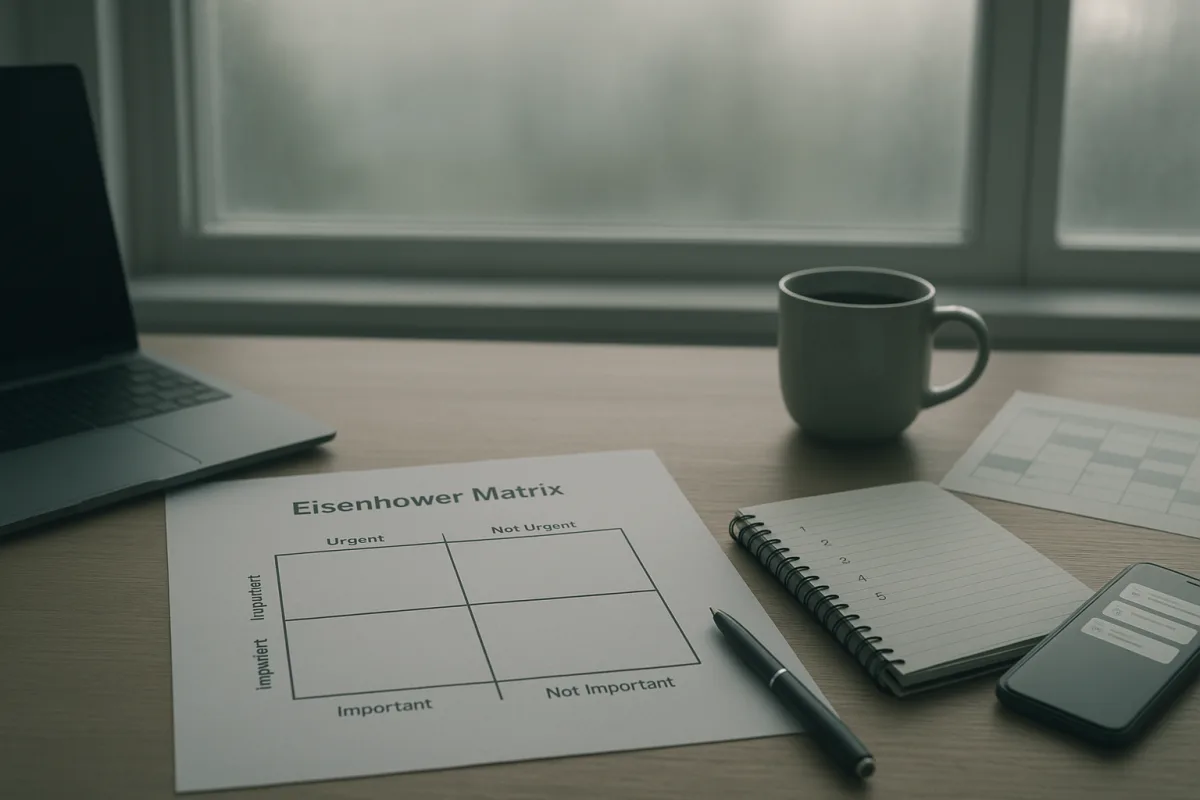
How to Prioritize Tasks Effectively for Better Productivity
Learn how to prioritize tasks effectively using proven methods like the Eisenhower Matrix and impact scoring to boost your productivity.
52 17 Productivity Technique for Remote Work Focus Cycles
Learn the 52 17 productivity technique for remote work: focus blocks and breaks that boost deep work and reduce distractions effectively.