
Set Work Boundaries to Improve Work-Life Balance and Focus
Learn how to set work boundaries, limit focused work hours, and schedule breaks to improve your work-life balance and reduce stress.
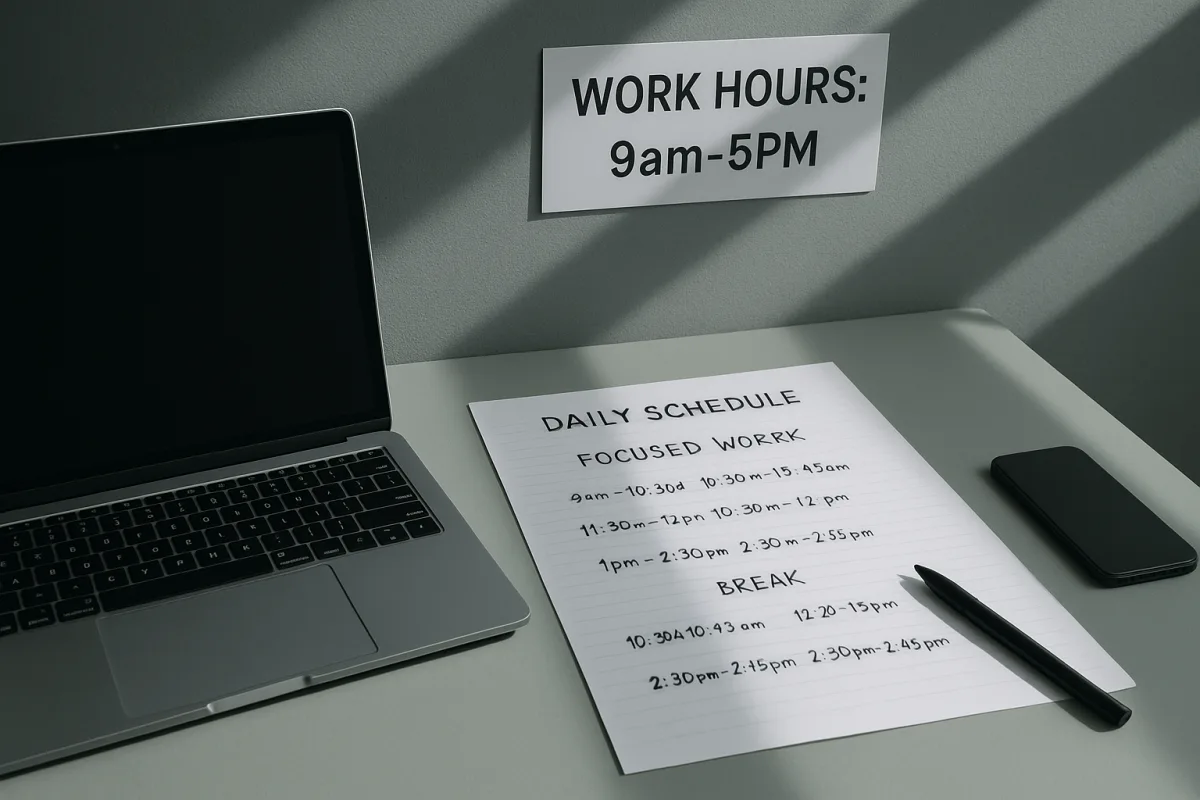
How to Establish a Work-Life Balance That Reduces Stress and Supports Better Work
Measure the week you actually have
Start with the calendar and task list from the last two weeks. Count your working hours, including early email checks, late messages, commuting, “quick” calls, and the work you finish after dinner because it did not fit into the day.
This can feel tedious. It is still the point where a work-life balance plan becomes real, because you cannot protect time that has not been accounted for.
Use three labels: focused work, reactive work, and personal time. Focused work includes writing, analysis, design, coding, planning, and other tasks that need sustained attention. Reactive work includes meetings, chat, email, requests, and approvals.
Then mark the places where work enters personal time. Perhaps your laptop stays open beside dinner, or you answer Slack while waiting for an appointment. You are looking for repeat patterns, not evidence that you have failed at managing your time.
A balanced workweek is commonly placed around 35 to 45 hours, with productivity declining when work exceeds 50 hours weekly. [5] That range will not fit every job, income need, caregiving arrangement, or deadline, but it gives you a ceiling to test.
We would pick one weekly number inside that range and track it for two weeks. If your role requires more, do not pretend a better app will solve a capacity problem. Record the extra hours and identify what creates them.
Set a limit for focused work, not only total work
A long workday can look productive because it contains many visible actions. Yet knowledge workers are often estimated to have about four to six hours of focused work available each day before efficiency and burnout risks rise. [4]
Treat that figure as a planning constraint, not a quota to hit. Four concentrated hours on a difficult report may be a full day of cognitively demanding work, even if you also spend hours in meetings and handling routine requests.
Block your first focused period before scheduling smaller tasks. Put the task name in the calendar, such as “draft client proposal” or “analyze monthly figures,” rather than writing “deep work.” The label should tell you what you will begin.
Reserve later parts of the day for communication, administrative work, and meetings where you can. If your calendar is controlled by others, protect at least one recurring block and make its purpose visible to colleagues.
Do not fill every open block with work. An overfull plan turns a delayed meeting or urgent request into an evening catch-up session. Leave space for the ordinary disruptions that make a normal workweek different from an ideal one.
Task overload without prioritization, multitasking, and overworking are recurring mistakes in attempts to improve work-life balance. [13] Choose one to three outcomes that would make the day count, then let lower-value tasks wait or be renegotiated.
Decide when your workday is over
Pick a finishing ritual that creates a visible handoff from work time to personal time. It can take ten minutes: list unfinished tasks, choose tomorrow’s first task, close work tabs, and put your computer away.
The goal is not to make yourself unavailable in every emergency. It is to stop treating every message as an emergency by default.
Write down your availability in concrete terms. For example: “I respond to messages until 5:30 p.m. weekdays,” or “I check email at 9:30 a.m., 1 p.m., and 4:30 p.m.” Tell the people affected by the boundary.
Constant availability and unclear boundaries can increase stress and undermine productivity. [10][13] If your workplace expects immediate replies, a personal decision to ignore messages may create conflict, so negotiate response expectations with your manager or team.
Use status settings, delayed sends, notification schedules, and separate work and personal profiles if your devices allow them. The feature matters less than whether your colleagues can see when a response is likely.
We would keep one narrow exception route for genuine urgency, such as a phone call from a manager or a designated on-call channel. Everything else can wait until the next working window.
Put recovery breaks inside the workday
Do not wait until you are depleted to take a break. Start with a repeatable schedule: a one-to-five-minute microbreak every 25 to 50 minutes, or a five-minute break after a 25-minute work interval. [7][8]
After roughly 90 minutes of sustained effort, try a longer break of 15 to 30 minutes. [7] The exact timing is not universal, so adjust the intervals after a week based on your work demands and whether you can return to the task.
Make the break physically different from the work you paused. Stand up, walk, stretch, get water, eat something, or spend a few minutes in mindfulness or meditation. These activities are associated with stress reduction during work breaks. [7][19]
Avoid turning every break into another stream of input. Opening social media may be enjoyable, but it can also make it harder to return to a report, spreadsheet, or complex conversation that needs your attention.
A break schedule breaks down when it becomes another performance target. If you miss one because you are presenting or handling a customer issue, take the next available pause. You have not ruined the system.
If stress, sleep, concentration, or mood problems are persistent or affecting daily functioning, bring them to a doctor or qualified clinician. A calendar routine can reduce friction around work, but it cannot diagnose or treat a health condition.
Choose the work location that gives you boundaries
Remote work is not automatically better for work-life balance. A University of Colorado study published in July 2026 found higher well-being among remote workers, with a reported mean score of 4.22. [1]
That benefit can coexist with blurred boundaries. TechRadar reported that Gallup’s third-quarter 2026 data put U.S. employee engagement at 29%, with remote workers down five points. [6] Your work location may help one part of your week while hurting another.
Test your arrangement against specific questions. Do you finish earlier at home because commuting disappears, or do you work later because your work is always in the next room? Do office days improve collaboration, or do they consume the hours you need for concentrated work?
Hybrid schedules may offer a middle route. Evidence on hybrid-work frequency indicates that a schedule around two remote days a week can produce favorable outcomes, though the right arrangement varies by role and employer. [3]
Younger workers may also want more office time because of loneliness and concerns about career advancement, Axios reports. [2] If that describes you, do not force a fully remote setup because it appears efficient on paper.
We would choose the arrangement that makes your start and finish times easiest to maintain. If remote work makes you feel permanently at work, add a walk before and after the workday, move work equipment out of sight, or ask for a hybrid pattern.
Protect personal commitments before work fills them
Put nonwork commitments in your calendar first: school pickup, dinner with a partner, exercise, appointments, family calls, or an evening with no plans. These are not rewards you earn after finishing every task.
OECD figures for 2020 place leisure and personal care at roughly 14 to 16.5 hours a day across measured populations. [15] Your own number will vary, but sleep, meals, care work, and basic life administration are part of the week, not empty space around work.
Choose two protected blocks to begin with. One might be a weeknight from 6:30 to 9 p.m.; another might be a weekend morning. Give each block a clear rule, such as no laptop, no email, or no work notifications.
Recovery time is often sacrificed first when deadlines build. [13] That can create a loop where tiredness makes tasks take longer, which then appears to justify taking even more personal time.
Regional norms shape what feels normal here. Nordic countries are often associated with workweeks of about 37 hours and rare overtime, while one 2026 comparison put the share working more than 50 hours at 26.5% in South Korea and 1.84% in the Netherlands. [15][16]
Your workplace culture may reward long visible hours. You may not be able to change that alone, but you can make the tradeoff visible by tracking it and raising workload concerns with evidence from your calendar.
Make communication rules with other people
A work-life balance system fails quickly when it exists only in your head. Tell your manager which projects fit your capacity, what will be delayed, and what needs a decision from them.
Use direct language: “I can complete the presentation by Thursday, or I can take on the new analysis for Wednesday. I cannot complete both to the same standard.” This turns vague overload into a decision someone can help make.
For teams, agree on response-time norms. A message sent at 7 p.m. can mean “read this tomorrow,” but many people read it as “answer now” unless the team says otherwise.
Poor communication and constant availability are common contributors to work-life stress. [13] A shared norm about urgency reduces the need to guess whether every notification deserves your attention.
If you manage people, avoid praising late-night replies as commitment. Rewarding them teaches the whole team that boundaries are risky, even when you say work-life balance matters.
Add one tool only after the rules exist
Choose an app to support a behavior you have already defined. Do not buy a complicated system in the hope that it will decide your priorities, boundaries, and workload for you.
TickTick combines task planning, habit tracking, and a Pomodoro timer, and its paid plan is listed at $4.17 per month in 2026. [17][20] It suits someone who wants tasks and timed focus sessions in one place.
Sunsama is a daily-planning tool built around more deliberate scheduling and is listed at $20 per month in 2026. [18][20] We would consider it only if daily planning is already a stable habit and the higher subscription cost fits your budget.
The Work Life Balance App tracks multiple life areas, Fabulous focuses on routines and coaching, and Headspace offers meditation and mood tracking. [18][20] These fit different problems: broader self-monitoring, building a repeated routine, or making short mindfulness sessions easier to start.
Start with a two-week trial using one tool. Track only three things: work hours, whether you completed your planned finish ritual, and whether you took breaks. More tracking can become another unpaid task.
At the end of the two weeks, keep the parts that reduced last-minute work and made personal time more predictable. Drop the rest. A work-life balance system earns its place by making an ordinary Tuesday easier to get through.
Frequently Asked Questions
How can I set effective work boundaries to improve work-life balance?
Build work boundaries based on your actual conditions, especially if you work remotely. Clearly communicate your availability, such as specific times when you respond to messages, and use tools like status settings or separate work profiles to signal when you are off work. Establish a finishing ritual to mark the end of your workday and negotiate response expectations with your manager or team to avoid constant availability.
What are practical finishing rituals to separate work and personal time?
A finishing ritual can take about ten minutes and include listing unfinished tasks, choosing the first task for the next day, closing work tabs, and putting your computer away. This creates a visible handoff from work to personal time and helps stop treating every message as an emergency. Keeping one narrow exception route for genuine urgencies, like a call from a manager, can help maintain boundaries while allowing necessary communication.
How many focused work hours should I plan per day for better balance?
Plan for about four to six hours of genuinely focused work each day, as this range supports productivity and reduces burnout risk. Treat this as a planning constraint rather than a quota, scheduling your most demanding tasks during these focused periods and reserving other times for meetings, emails, and administrative work.
What break schedules help maintain productivity and reduce stress?
Schedule short breaks of one to five minutes every 25 to 50 minutes and take longer breaks of 15 to 30 minutes after about 90 minutes of work. Break activities like standing, walking, stretching, mindfulness, and hydration can help reduce stress and improve productivity. Putting breaks on the calendar ensures they are part of your routine rather than an afterthought.
How do remote workers manage blurred work-life boundaries?
Remote workers should build boundaries that fit their real work conditions, as remote work can both support well-being and blur availability. Using clear communication about availability, status indicators, and separate work and personal profiles on devices can help. It is also important to recognize and address the risk of reduced engagement and negotiate expectations with colleagues to maintain balance.
How we researched this
This article was assembled from 20 cited references.
Nothing here is based on hands-on testing. Where a figure or finding appears, it belongs to the source cited beside it, and the writing says so rather than implying otherwise. Every source is listed below so you can check it.
Sources
- Rethinking return-to-office: the positive impact of remote work on well-being, connection, and employee retention - PMC
- Why Gen Z wants more office work
- Balancing Turnover and Promotion Outcomes: Evidence on the Optimal Hybrid-Work Frequency
- Optimal Work Hours Per Day: What Research Says About Productivity & Burnout - Zentrego
- Work-Life Balance Calculator - Assess & Improve Your Daily Balance
- UK workers are handling personal tasks during work hours - and they say it makes them more productive
- Microbreaks at Work Benefits: Science and a Simple Plan 2026
- When to Take Breaks at Work: Signs and Schedules - ScienceInsights
- How Is Work-Life Balance Arrangement Associated with Organisational Performance? A Meta-Analysis
- 'Always on' culture is harming productivity, so workers are demanding 'digital silence' to get on with tasks
- A Strategic Guide for Managing Hybrid and Remote Teams - Gallup
- Remote Work vs Office Work: 2026 Comparison | Zolvexio
- Common Mistakes When Trying to Balance Work and Personal Life | MoneyInOrder
- Work-Life Balance: Signs & Strategies | DesperateMinds
- How Cultures Around the World Define Work-Life Balance | Artikls
- Work-Life Balance by country: 2026 ranking | The Human Index
- The best productivity apps for Mac | Zapier
- The 9 best mindful productivity apps in 2026 (and how to choose) | Keelify
- I Tried 5-Minute Nervous-System Resets Every Day for a Week-This Is the One That Actually Worked
- Best Work Life Balance Apps in 2026 (Honest Comparison)
Related Articles

Manage Work-Life Balance
Learn how to manage work-life balance with clear boundaries, dedicated spaces, and focused work hours for better productivity and personal time.
52 17 Productivity Technique for Remote Work Focus Cycles
Learn the 52 17 productivity technique for remote work: focus blocks and breaks that boost deep work and reduce distractions effectively.
Implement Feedback Loops for Productivity: A Practical Guide
Learn how to implement feedback loops for productivity with clear steps, key metrics, and review tips to improve your work processes effectively.
How to Do Deep Work: Focused Productivity Explained
Learn how to do deep work with practical steps, session lengths, and focus strategies to boost productivity through distraction-free concentration.