
Mental Contrasting for Productivity Vision Boards That Work
Learn how mental contrasting boosts productivity vision boards by pairing goals with obstacles and actions for real motivation and follow-through.
How to Create a Productivity Vision Board That Still Helps on a Busy Wednesday
Start with the problem your board is meant to solve
Most vision boards fail before the scissors come out. They try to represent a whole improved life: better work, cleaner kitchen, more travel, fitness, friendships, savings, and a new career. That is not a productivity tool. It is a crowded wish list.
Psychology Today recommends defining a clear purpose and focus areas before choosing images. [1] For a productivity board, pick the work pattern currently costing you the most: unfinished priority work, unclear weekly planning, a portfolio project that never gets scheduled, or an overloaded calendar.
Write one sentence at the top of a blank page: “This board is for helping me…” Finish it with a concrete situation, not a personality judgment. “Complete my client proposal before reactive work takes over” is usable. “Become more disciplined” offers no decision to make.
Then choose one or two goals that can be measured. Pinsora recommends specific, measurable goals rather than broad aspirations. [2] A goal such as “write more” leaves you no way to tell whether Tuesday went well. “Draft 500 words for the report on Tuesday and Thursday” does not.
Keep the time horizon near enough that the board can affect your next few weeks. You do not need to make a claim about where you will be in five years to decide what belongs in tomorrow morning’s first work block.
A workable example might be: “Submit the project proposal by 30 June,” paired with “Hold three 45-minute research sessions each week.” The first is an outcome. The second is the repeatable work that gives the outcome a chance.
Do not mistake a pleasant collage for a plan
This is the uncomfortable part of vision boards. A board full of promotion photos, calm desks, finished books, and holiday images can feel motivating while you make it. That feeling is not the same as follow-through.
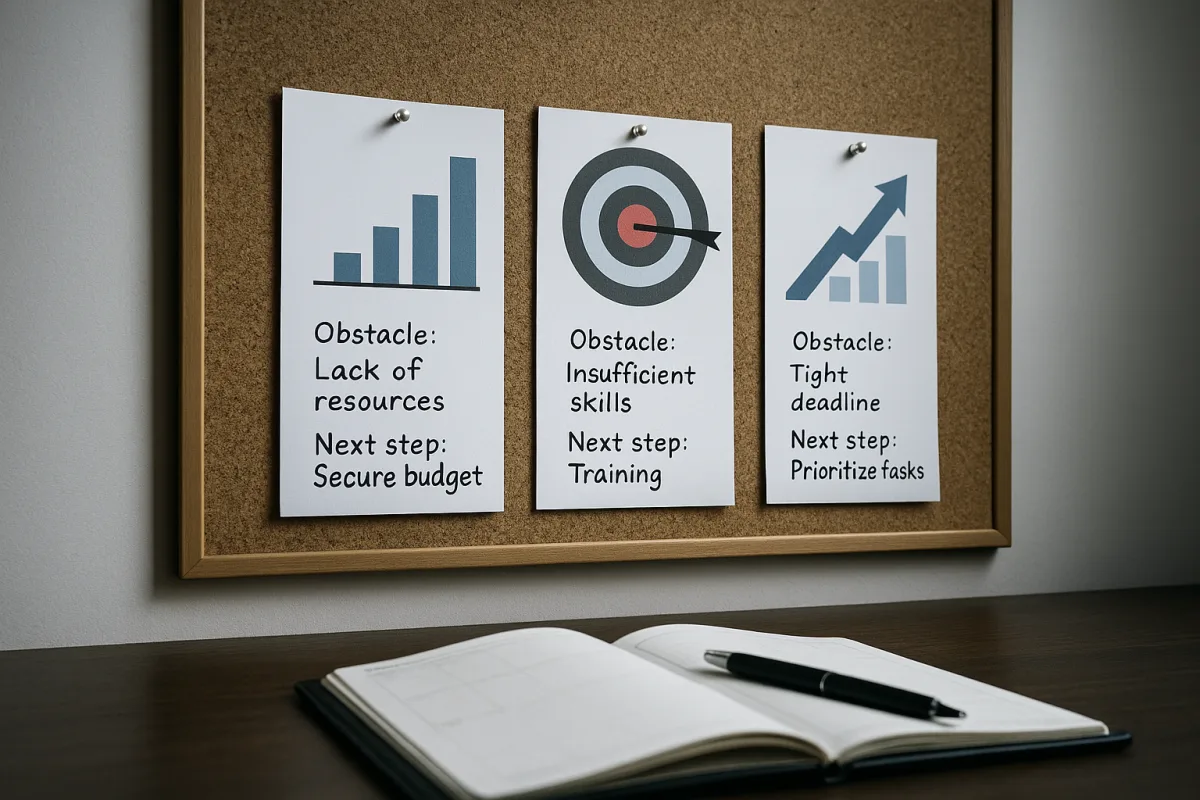
Good Life Goals cites research by NYU psychologist Gabriele Oettingen showing that positive fantasies alone can reduce motivation. [14] The useful corrective is mental contrasting: picture the desired result, then identify what is likely to get in its way.
For each goal, add four small pieces of information. You need the outcome you want, the benefit that matters to you, the obstacle you expect, and one action you will take when that obstacle appears. Kaizen similarly recommends linking vision-board goals to actionable steps. [3]
For example, a vague card saying “Finish my certification” could become: “Pass the exam in September.” Beneath it, write: “Obstacle: I answer messages during study time. Response: put my phone in another room for the first 30 minutes.”
That response is not glamorous, but it is the part that belongs on a productivity board. It turns an image into a prompt for behavior. A photograph of a completed qualification can stay, provided the obstacle and next step are visible beside it.
Use the same structure for focus. If the goal is “finish the first draft,” the obstacle may be starting with email because the draft feels ambiguous. The response might be: “Open the outline, write the next heading, and work for 20 minutes before checking messages.”
You are not predicting that an obstacle will disappear once named. You are reducing the amount of negotiation required when it arrives. That is the practical value of mental contrasting, not a promise that the board will produce motivation on demand.
Choose a size you can see and maintain
The right board size is constrained by where it will live. Vision Boards AI suggests letter size, roughly 8.5 by 11 inches, for a desk or bedside table; 11 by 14 to 18 by 24 inches for a home or office wall; and 24 by 36 inches or larger for a more extensive display. [5]
For a productivity board, a small board suits someone who works mainly at one desk and needs a compact visual prompt. A medium board is more forgiving if you need space for goals, obstacles, and progress marks without making the text microscopic.
A large board only helps if you have a stable, visible place for it. It can easily become decoration at the far end of a room. Visibility matters because Your Vision Board recommends putting the board where you will encounter it regularly. [4]
You do not need specialised supplies. 101 Planners lists poster board, cork board, and foam board as workable bases, with magazine cuttings, printed photos, postcards, markers, and stickers for content. [6] Cork is useful if goals will change often, because cards can be pinned and replaced.
Foam board is a more fixed option. KenYaGo estimates a basic board can cost about $10 to $30, including a base, images, and pens, while added embellishments or a kit can take the total to $30 to $70 or more. [15][16]
Those are craft-material estimates, not evidence that spending more improves results. A $3 to $10 foam board and home-printed images are enough. [15] If a design choice makes it harder to update an overdue goal, it is working against the board’s purpose.
Select images that mean something, then stop
The common urge is to fill every empty patch. Resist it. Terrames recommends a minimal selection of three to four meaningful images to avoid overwhelm. [9] That limit is especially useful when the board is meant to support work, where visual clutter competes with the focus you want.
Choose images that refer to the process as well as the result. A photo of a finished book may represent a writing goal, but a picture of a quiet library, a clear desk, or a calendar block may better remind you what producing pages actually requires.
Psychology Today recommends personally meaningful visuals and words. [1] “Personally meaningful” is the test. Do not add a luxury office, a public-speaking stage, or a six-figure salary graphic because it looks like the kind of goal productive people are supposed to want.
Granville College warns that boards become less effective when they reflect external expectations rather than personal goals. [11] If an image produces a small knot of obligation rather than a clear sense of direction, leave it out. Your board does not need to impress anyone else.
Add a limited amount of text. OCCO London and Wishframe recommend short, present-tense affirmations and quotes aligned with goals. [10][17] For productivity, make these statements specific enough to guide work: “I protect my first work block” is more useful than “I am unstoppable.”
A present-tense line can also describe the process: “I return to the proposal after interruptions,” or “I choose the next visible step.” These are not scientific interventions, and there is limited research on which quotes or image types improve focus. Treat them as cues, not evidence-based treatment.
Give the board a layout that answers a weekday question
Organise the board so your eyes can find the important information quickly. Psychology Today specifically advises arranging a board to maintain clarity and avoid clutter. [1] A simple three-part layout works well: outcome, obstacles, and this week’s actions.
Put one or two outcome images and measurable goals in the upper half. In the lower half, place obstacle cards and action cards. Reserve a narrow strip on one side for progress marks, such as boxes for this week’s planned focus sessions.
That progress strip matters because it keeps the board from becoming an imaginary future. Kaizen recommends actionable steps, and visual indicators such as checkboxes or progress bars make those steps easier to see as work is completed. [3]
Avoid putting too many life categories on one board. Champ notes that an exclusive focus on material goals can leave out emotional or experiential aims, while Granville College warns against overcrowding. [11][12] A productivity board can include “leave work with tomorrow planned” or “take a proper lunch,” if those are meaningful parts of sustainable work.
Still, this is not a medical or mental-health tool. If low mood, poor sleep, anxiety, or concentration problems are affecting your life, they deserve a conversation with a qualified doctor or mental-health professional, not a more elaborate board.
Make contact with the board part of your existing routine
Creating the board is the easy, finite task. Looking at it after the novelty wears off is the maintenance task. Vision Boards AI identifies neglect after creation as a common reason boards lose their effect. [5]
A realistic daily practice is brief. Claudia Brito suggests around one minute each morning. [7] Use that minute to read the main goal, name today’s action card, and check whether a known obstacle is likely to show up.
Do not turn this into a prolonged ritual that competes with the work itself. The daily check should end with a calendar decision, a task selected, or a physical first step. If it only produces a pleasant feeling, revisit the obstacle and response cards.
Once a week, spend 10 to 15 minutes checking progress and adjusting the board, as Bingo Vision Board recommends. [8] Remove completed action cards, replace unrealistic weekly targets, and ask whether your stated obstacle was actually the one that disrupted the work.
A monthly review can take about 30 minutes, according to Claudia Brito. [7] Use it to decide whether the goal still matters, whether the imagery still feels personal, and whether the board needs fewer commitments rather than more decorations.
Know when this format is a poor fit
A physical board will not suit every work situation. If you have no stable visible location, if other people need privacy around your goals, or if you cannot maintain a short review routine, its main mechanisms, regular exposure and updating, are weakened. [1][4][5]
That is not a failure of discipline. It is a mismatch between a visual system and the conditions of your week. In that case, keep the same ingredients, measurable goal, obstacle, response, and next action, in whatever planning system you already open reliably.
There is also no evidence in the supplied research that particular cultural or regional design styles make productivity boards more effective. Do not assume you need a certain aesthetic, colour palette, or set of symbols. Meaning, clarity, action steps, and regular review have more support than appearance. [1][3][14]
Frequently Asked Questions
What is mental contrasting and how does it improve vision boards?
Mental contrasting involves picturing the desired outcome and then identifying likely obstacles that could impede progress. This technique improves vision boards by pairing positive goals with realistic challenges, which helps maintain motivation and prepares you to respond effectively when obstacles arise. Research by NYU psychologist Gabriele Oettingen shows that positive fantasies alone can reduce motivation, so mental contrasting adds a practical layer to goal visualization.
How can I include obstacles and actions on a productivity vision board?
For each goal on your vision board, add a note about the obstacle you expect and one specific action you will take when that obstacle appears. For example, if your goal is to pass an exam, you might note the obstacle as distractions from your phone and the action as putting the phone in another room during study time. This approach turns images into prompts for behavior and reduces the need for negotiation when challenges arise.
Why do positive fantasies reduce motivation in vision boards?
Positive fantasies alone can reduce motivation because they may create a false sense of achievement without prompting actual effort. According to research cited by Good Life Goals, simply imagining success can decrease the drive to take necessary actions. Including obstacles and actionable responses through mental contrasting counters this effect by grounding your vision board in practical steps.
How do I use a vision board to overcome productivity obstacles?
Use the vision board to identify specific obstacles linked to your goals and plan concrete responses in advance. When you encounter a challenge, the board serves as a reminder of your intended action, reducing hesitation and increasing follow-through. This preparation helps you manage interruptions or distractions that typically derail productivity.
What practical steps make a vision board effective for work goals?
Start by defining one or two clear, measurable work goals focused on a current productivity problem. Pair each goal with an expected obstacle and a next action to address it. Use a small number of personally meaningful images and keep the board uncluttered for quick reading. Place the board where you will see it regularly and commit to brief daily reviews, weekly progress assessments, and monthly updates to maintain alignment with your goals.
How we researched this
This article was assembled from 17 cited references.
Nothing here is based on hands-on testing. Where a figure or finding appears, it belongs to the source cited beside it, and the writing says so rather than implying otherwise. Every source is listed below so you can check it.
Sources
- 6 Steps to Create Your Vision Board | Psychology Today
- 10 Steps to Create a Vision Board That Works — Pinsora
- Vision Board: How to Make One That Works & Ideas — Kaizen
- How to Make a Vision Board That Actually Works (2026 Guide) – Vision Board Studio
- Choosing the Right Dimensions for Your Vision Board | Vision Boards AI
- Vision Board Supplies & Materials: Everything You Need to Get Started
- Vision Boards: How It Works in Your Brain + How to Make One That Actually Works - lau
- The Weekly Review Ritual
- Vision Board Examples: Digital, Printable & Actionable
- Vision Board Quotes and Affirmations, Sorted by Life Area | Wishframe
- Vision Board 2026 Guide for Goals & Productivity
- Vision Boards That Work: Science-Backed Strategies for Manifestation | Champ
- Vision Board Coaching: The Ultimate 2025 Guide for Coaches — ANHCO
- How to Create a Vision Board That Actually Works | Good Life Goals
- Ultimate Vision Board Guide: Crafting Ideas & Goal Setting
- DIY Vision Boards Using Cricut
- Vision Board Maker: Tools That Actually Work — OCCO London
Related Articles

Visualization for Productivity
Learn how to use visualization for productivity with process-focused mental rehearsal to boost motivation and prepare for work tasks effectively.
How to Create a Vision Board for Goals That Work
Learn how to create a vision board for goals with clear actions, focused images, and tips to boost productivity and follow-through.
How to Create a Productivity Vision Statement That Guides
Learn how to create a productivity vision statement to clarify your focus, align with your values, and improve your work habits.
Using Feedback for Productivity Improvement
Learn how to use feedback effectively to improve your productivity with actionable steps and optimal feedback frequency.