
How to Create a Productivity Vision Statement That Guides
Learn how to create a productivity vision statement to clarify your focus, align with your values, and improve your work habits.
Start with the problem you actually want the statement to solve
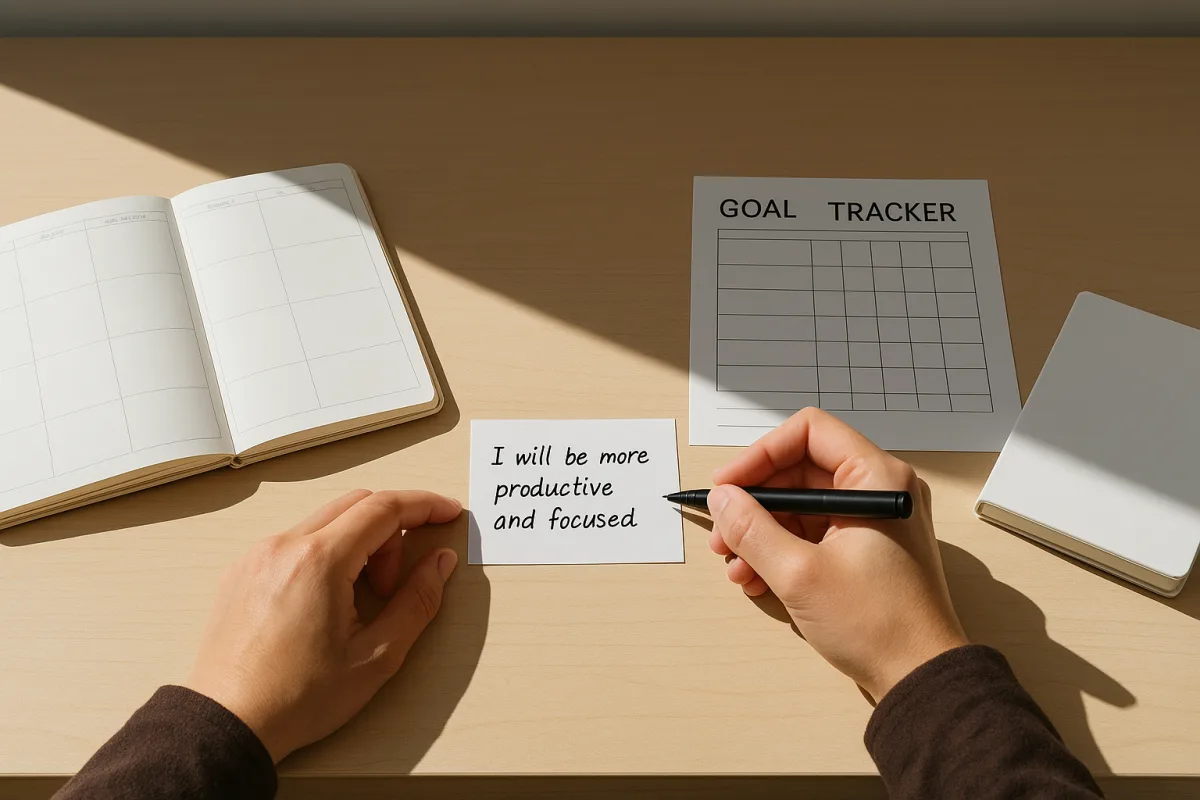
Most people begin with a blank page and produce something like: “I will be productive, focused and successful.” It sounds positive, but it cannot help with a real decision at 4 p.m. when two requests, an unfinished project and household responsibilities all compete.
A useful productivity vision describes the kind of working life you are trying to build. Effective vision statements are future-oriented, clear, aligned with values, memorable and achievable, according to guidance on organisational and personal vision development. [1][2][3]
That does not mean it must describe a flawless future. “I complete meaningful work calmly while protecting time for family” gives you a direction. It also exposes a trade-off: accepting every urgent request may conflict with the family-time part.
Before drafting anything, write down three recurring frustrations from the last two weeks. Use facts rather than personality labels: “I start client work late because messages fill the morning” is more usable than “I have no discipline.”
Then write what you want instead, in observable terms. Perhaps you want mornings reserved for concentrated work, projects finished before new ones begin, or a workload that leaves enough capacity for collaborators. This is the raw material, not the statement yet.
Do not confuse a vision with a mission, goal or task list
This is the first place the process tends to go wrong. A vision is the future direction. A mission is the purpose of what you do now. Goals are specific results, and tasks are the next physical actions.
For example, “I help small organisations communicate clearly” is closer to a mission. “Reduce proposal turnaround time by 15 percent in six months” is a goal. “Send the revised proposal by Thursday” is a task.
A productivity vision might say: “I deliver considered work on time without letting communication consume my day.” It gives you a basis for choosing practices, while leaving room to decide whether time blocking, a daily priority list or fewer meetings will do that job.
Guidance on vision-statement mistakes repeatedly warns against vague language, excessive complexity and mixing mission with vision. [9][10] If your sentence contains a list of current duties, software tools and deadlines, it is probably a plan wearing a vision-statement badge.
Find the values hidden inside your productivity goals
“Get more done” is not a value. It is an outcome that can mean very different things. One person wants more output to build a business. Another wants dependable work boundaries, fewer last-minute scrambles or more time for caregiving.
Use three prompts to find what matters underneath. Write a short answer to: “What work do I want to be known for?”, “What must productivity not cost me?” and “Which trade-off am I willing to make repeatedly?”
The second question matters because a vision statement can otherwise become an excuse to optimise the wrong thing. “Available to everyone at all times” may improve response speed, but it may conflict with concentration, quality or sustainable relationships.
Values alignment is consistently identified as part of an effective vision statement. [1][2][3] In practice, it asks you to name what you will protect when the calendar gets crowded, not merely what you would like to accomplish.
Draft a sentence short enough to use under pressure
There is no direct research establishing an ideal word count for a personal productivity vision statement. The commonly suggested one-sentence, 10-to-15-word range is borrowed from organisational vision-statement practice, so treat it as a useful constraint rather than a scientific rule. [4][5]
Start with this practical pattern: “I work in a way that [contribution], while [boundary or value].” Another option is: “I am building a working life where [future state] through [repeatable approach].”
Here are three examples with different priorities:
- “I finish high-value projects with enough space to think and recover.”
- “I make reliable progress on shared work while communicating early and clearly.”
- “I protect focused mornings for creative work and keep commitments realistic.”
Do not copy one because it sounds good. The point is to make the choice rule visible. A statement that does not rule anything out is probably too broad to guide behaviour.
Read the draft aloud once. If you have to pause to remember the middle, simplify it. Memorability and clarity are not cosmetic qualities here. The statement needs to be available when you are deciding whether to open another message or continue a difficult task. [1][3]
Make it achievable before making it inspirational
A vision should stretch you, but it should not require an imaginary life. Statements such as “I produce perfect work every day” or “I never miss a deadline” collapse the first time illness, a delayed dependency or an overloaded week appears.
Replace absolutes with durable direction. “I plan commitments honestly and flag risks early” allows for uncertainty while asking something concrete of you. It can still shape behaviour when the week goes badly, which is when a personal system earns its place.
Unrealistic aspirations are a documented vision-statement failure mode. [10] This is not an argument for lowering every ambition. It is an argument for writing a statement that can guide choices amid your actual obligations, finances, health and available support.
A productivity vision also cannot diagnose why work feels impossible. If low mood, poor sleep, attention changes or persistent exhaustion are affecting your ability to function, that is a question for a doctor or qualified clinician, not a wording problem to optimise.
Put the numbers underneath the statement
Readers often try to make the vision measurable by packing metrics into it. That usually produces a sentence nobody remembers. Keep the vision directional, then attach one to three measurable goals that show whether your current system supports it.
For the statement, “I finish high-value projects with enough space to think and recover,” supporting goals might be: complete the current project by a specific date, hold two 90-minute focus sessions on three weekdays, and keep one evening a week free of work.
Use the SMART framework for those supporting goals: specific, measurable, achievable, relevant and time-bound. [6] “Reduce project completion time by 15 percent in six months” is measurable. “Be more efficient” gives you no way to tell whether a change helped.
Be careful with what you measure. Counting hours, inbox replies or completed tasks can be useful if they connect to the vision. They are less useful if they encourage fast responses at the expense of the considered work you said mattered.
The evidence here is indirect. Guidance on measurable criteria comes largely from organisational goal setting, not studies of personal productivity vision statements specifically. [6] Use metrics as feedback, not as proof of personal worth.
Check whether the language fits your context
A statement built around personal achievement and punctuality may feel natural in many Western workplaces. Other cultural contexts may place more weight on collective success, harmony, relationships, flexibility and communication. [11][12][13]
Neither approach is inherently more productive. They simply make different demands visible. “I protect uninterrupted deep-work blocks” may fit an individual contributor. “I make commitments visible early so the team can coordinate” may fit work where others depend on your availability.
Time also has cultural meaning. Linear, deadline-led work cultures tend to reward structure and punctuality, while more relationship-oriented or polychronic contexts may treat flexibility and responsiveness as essential parts of good work. [11][12]
Write the statement for the people and obligations you actually have, not for a productivity culture you encountered online. If your work relies on family, clients or a team, ask one affected person whether the statement describes a workable version of you.
Developing a vision in isolation is another recognised failure mode. [10] You do not need a committee to write a personal statement, but someone close to the consequences can spot a promise that sounds admirable and creates friction in practice.
Use a template only when it removes a real obstacle
Templates can help if the blank page is the barrier. They do not replace the thinking about trade-offs, and an elaborate visual board is unnecessary if a single sentence and three goals are enough.
QuestModeLife’s Personal Mission Statement Generator is free and requires no signup. Its gamified approach may suit someone who wants prompts and a structured starting point, but it is less useful if turning reflection into a game feels distracting. [14]
Eisenhower’s free Vision Board Template is printable and organised around self, social and security pillars. It may suit someone who thinks visually and wants productivity connected to broader life priorities, rather than confined to work output. [16]
Notion’s Vision & Goals Hub Template costs $39 and is positioned as a psychology-based, multi-year planning tool. It suits people already using Notion who want a more substantial planning workspace, not someone seeking a one-sentence statement without further administration. [17]
Atlassian’s Confluence Vision Board Template is team-oriented and designed for visual alignment. The source does not state a price. It is better suited to a group clarifying shared direction than to an individual who simply needs a personal decision rule. [18]
Template.net’s AI Vision Statement Generator is free and requires no signup. It can produce wording options quickly, but treat its output as a draft to interrogate. An AI-generated statement cannot know which commitments, cultural expectations or boundaries are real in your week. [19]
Build the statement into a small weekly practice
A vision statement hidden in a notes app does nothing. Put it at the top of your weekly plan, then use it for one decision: identify the single commitment most aligned with it and one commitment that conflicts with it.
This is what the method actually asks daily. It does not require rereading the sentence as a motivational ritual. It requires noticing when your calendar, task list or communication habits repeatedly contradict the direction you chose.
At the end of the week, ask three questions: What action supported the vision? What repeatedly pulled against it? What will I change next week, one commitment, boundary or scheduling choice at a time?
Keep this review short. Frequent review of near-term goals can coexist with less frequent revision of the broader vision. Practical guidance supports combining regular short-term reviews with occasional comprehensive reassessment. [20]
Revise when the direction changes, not because Tuesday was messy
Advice on revision intervals varies considerably. Some sources recommend annual reviews, while others suggest revisiting vision statements every three to five years. [7][8] That disagreement is useful: it means a fixed calendar rule is not well supported.
Review the wording when a meaningful change occurs: a new role, changed care responsibilities, a shift from solo work to team leadership, altered financial needs, or a discovery that the statement consistently produces the wrong trade-offs.
Do not rewrite it after every unproductive week. First inspect the system underneath it. If “protect focused mornings” keeps failing because meetings are routinely scheduled then, the practical fix may be calendar boundaries, not a new personal vision.
The statement has done its job if it makes that diagnosis easier. It should clarify what you are trying to protect, show where your current commitments disagree, and give you a modestly better basis for choosing what happens next.
Frequently Asked Questions
What is a productivity vision statement?
A productivity vision statement is a future-oriented description of the kind of working life you want to build. It provides clear direction to help make decisions and prioritize commitments, rather than listing daily tasks or goals. It should be aligned with your values and be memorable and achievable.
How do I write a personal productivity vision statement?
Start by identifying recurring frustrations and what you want instead, using observable facts rather than vague aspirations. Then write a concise, future-facing sentence or two that describes your desired work life and the trade-offs you are willing to make. Avoid mixing it with mission, goals, or task lists.
What should a productivity vision statement include?
It should include a clear, specific, and future-focused direction that reflects your core values and the kind of work you want to be known for. It should also acknowledge trade-offs you are willing to accept and avoid vague or overly complex language. Measurable targets belong in supporting goals, not in the vision statement itself.
How long should a productivity vision statement be?
Typically, one or two sentences are sufficient, ideally about 10 to 15 words. This length helps keep the statement clear, memorable, and easy to use when making decisions.
How can a productivity vision statement improve focus and habits?
By providing a clear direction aligned with your values, a productivity vision statement helps you choose between competing commitments, especially during difficult weeks. It guides your habits and practices by clarifying what kind of work life you want to build, making it easier to prioritize effectively.
How we researched this
This article was assembled from 20 cited references.
Nothing here is based on hands-on testing. Where a figure or finding appears, it belongs to the source cited beside it, and the writing says so rather than implying otherwise. Every source is listed below so you can check it.
Sources
- Key Characteristics of a Vision Statement Explained
- Vision and Mission Statement Examples What Makes Them Effective - FasterCapital
- The Strategic Vision of an Organization: A Research-Based Guide
- Vision Statement: How long it should be, examples, and how to write one that actually gets used | Tability Blog
- Mission and Vision Statement Templates | Smartsheet
- SMART Goals at Work: Benefits, Criteria and Examples
- How to Review and Update Your Vision and Mission Statements
- When You Should Revise Your Mission Statement
- How to Write a Vision Statement? Mission vs Vision Statement
- Common Mistakes In Vision Statement Development
- Western Ideas Of Productivity V. Eastern Productivity Ideas
- Is Your Organization Ready to Go Global? | Workforce Development | Wilson Learning Worldwide
- How does what people want from work differ per region? - Effectory
- Free Gamified Productivity Tools | Mission Statement Generator & Life Planning Templates - QuestModeLife
- Eisenhower Matrix Printable PDF | Task Prioritization Worksheet | Productivity Planner | Blue Time Management Template - Etsy
- Free Productivity Templates and Printable PDFs - Eisenhower
- Vision & Goals Hub Template | Notion Marketplace
- Шаблон Шаблон доски концепции | Confluence
- Free AI Vision Statement Generator, Vision Statement Maker [ No Signup ]
- How Often Should You Review and Update Your Work Goals?
Related Articles
How to Create a Personal Development Plan That Works
Learn how to create a personal development plan with clear goals, weekly milestones, and habit strategies to boost your growth and productivity.
How to Create a Vision Board for Goals That Work
Learn how to create a vision board for goals with clear actions, focused images, and tips to boost productivity and follow-through.
Create an Effective To-Do List: Tips for Better Productivity
Learn how to create an effective to-do list with actionable tasks, prioritization, and daily planning to boost your productivity.

How to Create a Personal Productivity Dashboard That Works
Learn how to create a personal productivity dashboard with key metrics, project tracking, and review tips to boost your focus and progress.