
How to Create a Personal Productivity Manifesto
Learn how to create a personal productivity manifesto with clear principles and trade-offs to guide your work and focus.
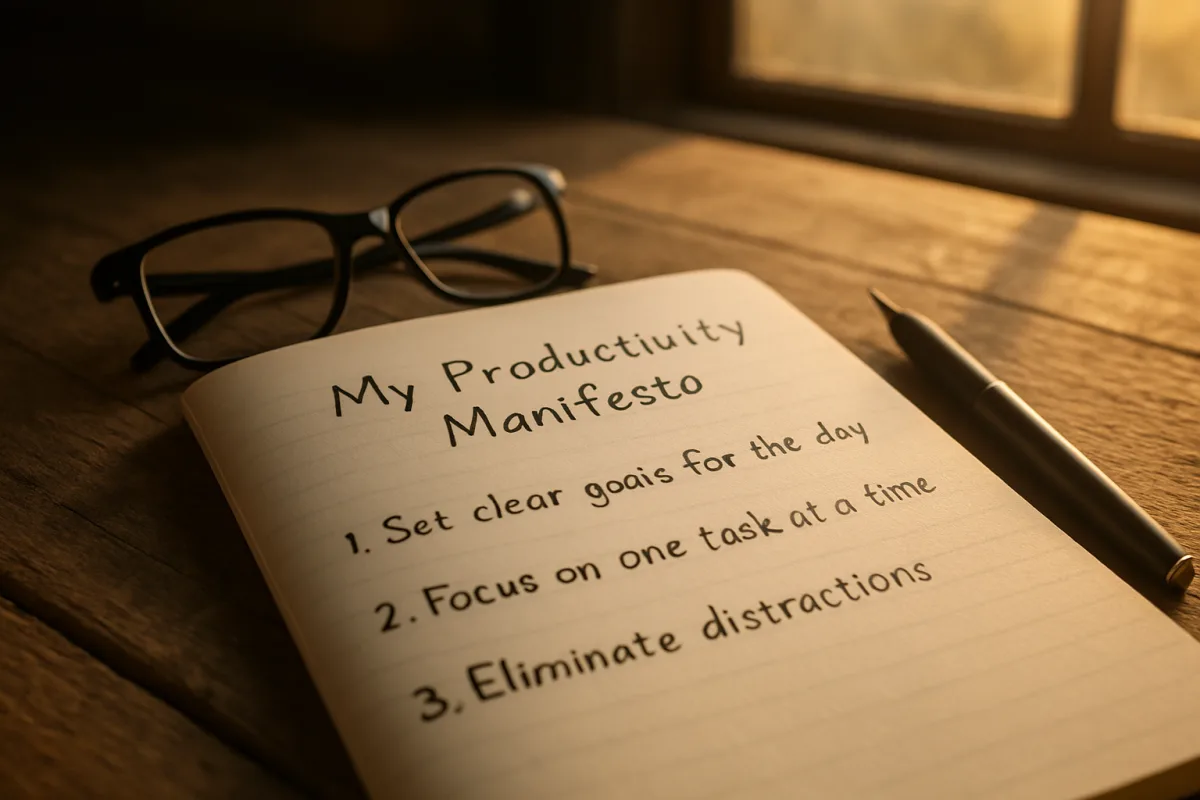
Put a title at the top of a blank page
A blank note titled “My Productivity Manifesto” gives you a place to start. Under it, write one opening statement about who you are, the work you want to do, and the direction you want that work to take. [2][3]
Keep this opening in your own language. “I want to be a reliable project lead who makes room for careful work” gives you something to test against a packed Tuesday in a way that “maximize performance” does not.
A personal productivity manifesto is a declaration of principles, goals, and values. It can bring clarity and intention to your work, but it is not a validated productivity intervention: no published evidence here quantifies output improvements from creating one. [1][20]
We would begin with a plain document, not a designed template. The job is to name what you want to protect when requests, deadlines, and competing priorities make every task look equally urgent.
Choose the size of the first draft
Set a boundary before you start writing: make a 25-minute draft, or give yourself a longer reflection period. Entrepreneur proposes a 25-minute process, while therapist Blake Anderson frames manifesto-building as a guided 12-week reflection. [5][8]
Neither timeline is mandatory. A quick session suits the person who has been circling the same priorities for months and needs words on paper; a longer process suits someone whose work, responsibilities, or goals are changing substantially.
Do not treat the first version as a permanent statement about your character. It is a working document for the conditions you have now, including the kind of work you do and the constraints you cannot remove.
If 25 minutes is all you can protect this week, use it. If your draft feels vague because you have not yet sorted through competing commitments, leave placeholders and return later instead of forcing a polished declaration.
Write raw lines before you organize them
Give yourself a page for unfiltered material. Rob Cressy recommends generating 20 to 40 lines before organizing them, which keeps you from editing each sentence before you have identified what actually belongs in the manifesto. [6]
Write lines that begin with prompts such as: “I want my workday to include,” “I do my best work when,” “I will protect,” “I will stop pretending matters,” and “I want colleagues to experience me as.”
Include friction, not only aspirations. If back-to-back meetings leave no time to complete the work they generate, write that down. If being available to your team matters, write down what availability can realistically mean.
Then underline repeated ideas. You may find that several lines about finishing, fewer meetings, and protected concentration all point to one principle. This is the material you will shape, not a list of inspirational phrases you feel obliged to adopt.
Select three to five core principles
Choose three to five principles that can influence daily work. Common manifesto formats use a small set of core principles, each paired with an explanation of how it guides behavior. [2][3][4]
Name each principle with a word or short phrase: “Finish before expanding,” “Make commitments visible,” “Protect recovery time,” or “Ask before assuming urgency.” The label should be easy to recognize during a week when you have little patience for rereading prose.
Under each one, write two or three sentences describing its everyday meaning. “Finish before expanding” might mean you complete the current project milestone before volunteering for a new initiative, unless your manager changes the priority.
Avoid principles that only sound admirable. “Excellence” is hard to use without a definition. “Send the decision memo by Friday, even if it is imperfect” states a standard you can recognize when the work is taking longer than planned.
We would keep principles that change a calendar or task-list choice. If a line cannot tell you what to begin, postpone, decline, or complete, move it to a separate page of aspirations.
Turn each principle into a trade-off
Values become harder to follow when they never cost you anything. For each principle, write one decision that reflects it and one competing behavior you will limit, because a manifesto needs to address the trade-offs behind your priorities. [2][3]
For example, “Protect deep work” could mean blocking two mornings for project work and declining meetings that lack an agenda or a decision you need to make. “Be responsive” could mean answering urgent team questions within an agreed window, not monitoring every channel continuously.
This section prevents two values from quietly canceling each other out. You may value generosity and boundaries, speed and care, ambition and time with family. The manifesto cannot erase those tensions, but it can tell you how you intend to handle them.
Write the trade-off in language that fits your authority. An employee may say, “I will raise workload conflicts early.” A manager may say, “I will not create same-day deadlines without explaining why the deadline changed.”
Add a vision that reaches beyond this week
Write a short vision statement after the principles. Its purpose is to connect current actions with a longer-term direction, such as the kind of contributor, manager, craftsperson, or teammate you want to become. [3][4]
Keep it specific enough to guide current work. “Over the next few years, I want to build a reputation for clear decisions and dependable follow-through” can support choices about preparation, communication, and what commitments to accept.
Do not turn this into a five-year plan with dates, income targets, or milestones unless those are central to your own goals. A manifesto has no standardized format, and borrowed detail can make it feel like another planning system to maintain.
Add a daily affirmation only if you will actually read it. Personal-manifesto frameworks often include affirmations that reinforce the principles and vision, but a sentence like “Today I will protect the work that advances my commitments” is enough. [4]
Fit the manifesto to the work you actually do
Read the draft beside your calendar, task manager, and the expectations of your role. A principle that fits a solo writer may not fit someone supporting customers, supervising a team, or working across several time zones.
Distributed work offers one example. TechRadar reports that timeboxing calendars improved progress for 68% of more than 12,000 Atlassian employees, but a calendar-first approach only belongs in your manifesto if your work allows you to protect those blocks. [11]
Adapt the method, not your life to the document. Guidance on Getting Things Done emphasizes adapting the framework to different work styles, which applies here too: your manifesto should account for how you capture tasks, collaborate, and recover from interruptions. [18]
Check for team friction before you make a private preference into a personal rule. A commitment to slow, considered responses may conflict with a team that needs rapid escalation coverage. State how you will meet the shared obligation, then protect what remains.
We would skip any principle that makes you less clear to the people who depend on you. Your manifesto can set boundaries, but it needs to acknowledge the commitments that come with your job.
Choose one place to keep it
Put the finished document where you already plan and review work. Notion and Evernote can hold a manifesto alongside linked projects and notes, while a notebook or binder can suit someone who thinks better on paper. [10]
Do not create a new app, dashboard, or elaborate visual system solely for this document. Organizing can become a substitute for execution, and systems that demand frequent upkeep can create maintenance fatigue. [13][19]
If you use a digital system, pin the manifesto and link it from your weekly review note. If you use paper, place it at the front of the notebook you open for planning, not in a separate journal you rarely reach.
You can also connect it to an existing framework. PARA provides a way to organize projects, areas, resources, and archives, while Getting Things Done centers on capturing and reviewing commitments. [9][18] The manifesto supplies the criteria those systems do not provide: what deserves your attention.
Set a review rhythm before you need one
Put two review appointments on your calendar now: a brief weekly check-in and a fuller review after three to six months. Weekly reviews can keep your principles connected to current work, while longer reviews allow for changes in goals and circumstances. [16][17]
During the weekly check-in, ask three questions: Which principle guided a decision this week? Where did a stated trade-off fail under pressure? What one adjustment would make next week’s commitments better match the document?
At the longer review, read the manifesto from top to bottom. Remove language that no longer reflects your work, rewrite principles that have become too broad, and add constraints you have learned through experience.
Quarterly reviews are also commonly recommended, while other approaches use a 12-week guided process. [7][8] Pick a rhythm you can sustain. Missing a review is information about the schedule or the document, not a reason to abandon it.
Cut anything that creates maintenance work
Before you call the manifesto finished, reduce it. Overcomplication can produce maintenance fatigue and leave less attention for actual work, while inflexible systems can break when a workload or personal circumstance changes. [13][15]
Read each sentence and ask whether it directs behavior. Delete duplicate principles, decorative quotes, elaborate scoring systems, and promises you cannot check against a real workday. A manifesto is there to clarify priorities when your attention is already limited.
Leave room for revision. The Gentle Productivity Manifesto includes the principle that rest is part of work rather than a reward, a reminder that a personal system can account for limits instead of demanding constant output. [12]
Keep the version you will reread. A page of direct statements, concrete trade-offs, and a review date will serve you better than a document that looks complete but stays closed.
Frequently Asked Questions
What is a personal productivity manifesto?
A personal productivity manifesto is a concise declaration of your principles, goals, and values related to your work. It clarifies what you want your work to stand for and guides how you handle everyday decisions about tasks, calendar events, and communication. It is not proven to directly increase measurable productivity but can bring clarity and intention to your work.
How do I create a personal productivity manifesto?
Start with a blank page titled “My Productivity Manifesto” and write an opening statement about who you are and the kind of work you want to do. Generate 20 to 40 raw lines responding to prompts like “I want my workday to include” or “I will protect,” then underline repeated ideas to identify core themes. From these, select three to five core principles that influence daily work choices, and describe each principle’s practical meaning.
What principles should be included in a productivity manifesto?
Include three to five clear principles that guide your daily work decisions, such as “Finish before expanding” or “Protect recovery time.” Each principle should be paired with an explanation of how it affects your behavior and include a trade-off, what you will protect and what you will decline when priorities compete. Avoid vague or purely aspirational terms without concrete actions.
How can a productivity manifesto improve my work habits?
A manifesto helps by clarifying your values and priorities, making it easier to decide what to start, postpone, or decline when faced with competing demands. It provides a framework to protect what matters most in your work and recognize trade-offs, which can reduce friction and increase intentionality in daily choices.
How often should I revise my personal productivity manifesto?
Revision schedules vary depending on your work and goals. You might do quick weekly check-ins to stay aligned and a fuller review every three to six months. The manifesto is a working document meant to evolve with your changing responsibilities and priorities.
How we researched this
This article was assembled from 21 cited references.
Nothing here is based on hands-on testing. Where a figure or finding appears, it belongs to the source cited beside it, and the writing says so rather than implying otherwise. Every source is listed below so you can check it.
Sources
- Personal Productivity and Well-being -- Chapter 2 of the 2021 New Future of Work Report
- Personal Manifesto: How to Write One That Holds Up | Attain OS
- Manifesto: Purpose-Driven Productivity - Intend
- Personal Manifesto, Free Interactive Manifesto Builder | Fabulous
- Create Your Personal Manifesto in 25 Minutes
- How to Create a Personal Manifesto (The Intention, Awareness, Consistency Method) | Rob Cressy
- Create your Personal Manifesto - Action from Finish What You Start: The Art of Following Through, Taking Action, Executing, & Self-Discipline | Mentorist
- Craft a Personal Manifesto for Clarity, Blake Anderson | Therapy
- How to Build a Productivity System From Scratch | Productivio
- My Favorite Productivity Methods: A Practical Stack
- 4 ways to boost personal productivity in a distributed world
- The Gentle Productivity Manifesto · Wardesk
- Productivity Pitfalls: When Organizing Replaces Real Work
- Common Productivity Systems Mistakes and How to Avoid Them - Prepare To Activate
- Why Most Productivity Systems Fail You (And What Actually Works for Sustainable Output) | Paperchronicle
- Crafting a Personal Manifesto: A Guide to Your Purpose and Passion - Slow Rooted Life
- Personal Growth Plan Guide You’ll Actually Follow
- Adapting GTD to Different Work Styles | Getting Things Done
- 12 Common Productivity Pitfalls and How to Fix Them (2026)
- Personal productivity: what the evidence really says | Prodability
- Why personal productivity (alone) fails
Related Articles
How to Create a Productivity Vision Statement That Guides
Learn how to create a productivity vision statement to clarify your focus, align with your values, and improve your work habits.

Implement Feedback Loops for Productivity: A Practical Guide
Learn how to implement feedback loops for productivity with clear steps, key metrics, and review tips to improve your work processes effectively.

How to Create a Personal Productivity Dashboard That Works
Learn how to create a personal productivity dashboard with key metrics, project tracking, and review tips to boost your focus and progress.
Using Feedback for Productivity Improvement
Learn how to use feedback effectively to improve your productivity with actionable steps and optimal feedback frequency.