
Best Productivity Journals
Compare the best productivity journals, Full Focus Planner and BestSelf 13-Week Self Journal, to find the right fit for your goal tracking needs.
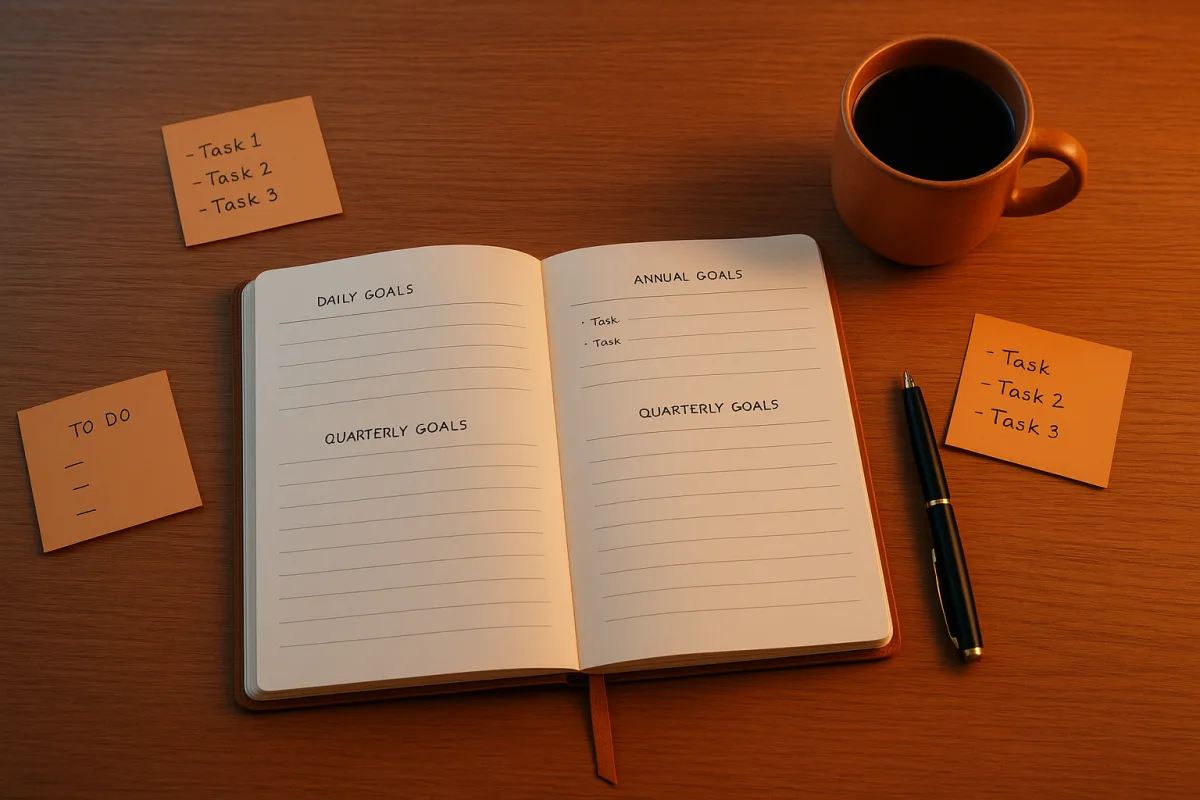
The decision: Full Focus Planner or BestSelf 13-Week Self Journal?
The best productivity journal for tracking progress is not necessarily the one with the most trackers. It is the one that gives you a small number of signals you can still read on a busy Thursday.
For this decision, the two serious options are the Full Focus Planner by Michael Hyatt, a premium goal-to-daily-action planner, and the BestSelf 13-Week Self Journal, a premium undated journal built around a focused 13-week execution cycle. [3][16]
They overlap. Both ask you to identify priorities, plan work in shorter intervals, and review progress rather than trusting memory. Neither is a blank notebook, and neither is a lightweight diary.
The difference is the time horizon. The Full Focus Planner starts with annual goals, moves through quarterly targets and weekly priorities, then asks for daily action. Its daily page uses a “Big 3” list: the three tasks that make the day successful if completed. [1][2]
The BestSelf 13-Week Self Journal is more deliberately bounded. Its central proposition is that 13 weeks is enough time for meaningful progress but short enough to force choices, with weekly reviews intended to show what is working and what needs changing. [3][16]
That makes this less a contest over paper quality or cover design than a decision about planning temperament. Do you need a long-range map, or do you need a manageable season of concentrated work?
There is an evidence limit worth stating before going further. The research brief identifies many highly rated planners, but no comprehensive evidence says journal preferences reliably vary by profession, by systems such as Getting Things Done or Bullet Journal, or by demographic group.
Broader research on productivity interventions suggests culture can affect whether a system is adopted and how useful it feels. That does not tell us which of these two journals works best in any particular region or workplace. It means universal recommendations should be treated cautiously.
Head-to-head: tracking progress in a real week
| Criterion | Full Focus Planner by Michael Hyatt | BestSelf 13-Week Self Journal |
|---|---|---|
| Core tracking model | Tracks alignment from annual goals to quarterly goals, weekly priorities, and daily actions. | Tracks progress through one defined 13-week cycle, supported by weekly reviews. |
| Daily demand | Requires daily planning and choosing a Big 3. | Requires regular daily use, but the central accountability loop is the weekly review. |
| Best progress signal | Whether daily work continues to serve higher-level goals. | Whether a focused commitment is moving forward, stalling, or needs revision. |
| Planning horizon | Long, with annual and quarterly planning built into the system. | Shorter and more contained, with a 13-week frame. |
| Where it breaks | Can become administrative if annual goals, quarters, weeks, and days all receive equal attention. | Can feel disconnected if you need to manage a complex annual plan or many simultaneous projects. |
| Best suited to | Goal-driven people who want daily work tied to quarterly goals. | People rebuilding a working rhythm after burnout or pursuing a selective 13-week execution plan. |
| Relative price position | Premium. | Premium. |
| Evidence limit | No independent comparative evidence establishes that its structure improves productivity more than competing journals. | No independent comparative evidence establishes that its 13-week format improves productivity more than competing journals. |
1. What each journal asks you to track
The Full Focus Planner asks for vertical alignment. A task is not simply something to finish. It should sit beneath a weekly priority, which sits beneath a quarterly target, which serves an annual goal. [1][2]
That can be genuinely useful when work gets crowded. If your daily list keeps filling with messages, small requests, and maintenance tasks, the planner creates a visible place to ask whether those jobs are replacing the work you said mattered.
Its “Big 3” is the practical part of the system. Three completed priorities are easier to review than a sprawling task list, and the rule prevents progress from becoming synonymous with doing the most small things. [1][2]
But the same hierarchy can be a burden when your work is reactive. A customer-support lead, caregiver, clinician, or manager handling urgent changes may have days where the plan is repeatedly overtaken by legitimate demands.
The BestSelf 13-Week Self Journal asks a different question: what can you move noticeably in one season? Instead of maintaining an elaborate annual architecture, it asks you to be selective enough that weekly progress remains visible. [3][16]
That shorter frame may be more forgiving for somebody returning to structured work after a difficult period. The journal is explicitly positioned for people rebuilding their working rhythm after burnout, though a planner is not treatment for burnout or any health condition. [16]
Its weekly review is the important feature for progress tracking. Checkmarks tell you that an action occurred. A review can tell you whether that action helped, whether the goal was unrealistic, or whether the plan kept colliding with the same constraint.
2. The daily burden
A planner works only to the degree that its repeated questions remain answerable. Both of these journals have more daily and weekly structure than a blank notebook, which is their strength and their main failure mode.
The Full Focus Planner’s demand is clear: decide the day’s Big 3 and maintain the link between daily work and longer-term goals. For people who like decisions made on paper before work begins, this can reduce the ambiguity of an open day.
For people who dislike pre-planning, it can create a familiar failure pattern. Miss a few pages, feel behind in the planner itself, then avoid opening it because catching up appears to require reconstructing several days of work.
The BestSelf journal also requires attention, but its 13-week container reduces the feeling that every imperfect day damages a grand annual project. A bad week is still material for the next review, not necessarily evidence that the whole system has failed.
That is not a claim that shorter cycles produce better habits. The brief does not provide comparative research establishing that outcome. It is a design difference, and whether it helps depends on how you respond to planning friction.
3. The quality of the review loop
For tracking progress, this is the closest category. Both journals understand that tasks need a review cycle. The Full Focus Planner reviews alignment, while the BestSelf journal reviews execution over a shorter period.
The Full Focus approach is better when you have several goals that must coexist, such as building a qualification, managing a business project, and protecting time for a personal commitment. Its hierarchy can show when one area has quietly consumed the others.
It also has a risk: you can spend more time maintaining the hierarchy than using it. A goal system becomes decorative when every task is dutifully classified but no one asks whether the quarterly target was the right target.
BestSelf’s 13-week review process is better at confronting that question sooner. It gives you recurring opportunities to ask what is working before an unhelpful commitment occupies six months of your calendar. [3][16]
Its weakness is that a weekly review cannot supply strategic direction on its own. If you have not selected a meaningful goal, it may help you execute a vague plan more consistently, which is not the same as making progress.
This is where common tracking mistakes matter. Productivity-tracking guidance repeatedly warns against vague goals, excessive habit lists, inconsistent use, perfectionism, and measuring activity rather than results. [12][13][14]
Either journal can amplify those mistakes. A Big 3 can become three vague intentions. A 13-week cycle can become 13 weeks of recording a habit without deciding what result the habit is meant to support.
How the rest of the field fits
The two finalists are not the only reasonable productivity journals. They are the better comparison if your main need is structured progress tracking across meaningful goals, rather than gratitude, free-form notes, or app-supported coaching.
The Focus 360 ADHD Planner is a premium option for people seeking an ADHD-oriented comprehensive planner. Its weekly spread places a habit tracker prominently at the top, making progress feedback immediately visible. [15]
That visible feedback may suit someone who benefits from seeing a streak or a completed action without flipping pages. The product reporting links immediate, visible feedback with habit reinforcement for people with ADHD, but this does not make a paper planner a substitute for clinical assessment or care. [15]
The Phoenix Journal - Quarterly Goal Planner is another premium choice, aimed at people who want structured 12-week goal setting. It suits someone who wants the quarterly focus of BestSelf’s journal but prefers a product explicitly framed around goals and productivity. [24]
The Roterunner Purpose Planner Notebook B5 is a mid-range alternative for people who want daily, weekly, and monthly planning in one place. Its B5 format is larger than the common A5-style planner, designed to make a whole week easier to see while remaining portable. [17]
The Clever Fox Planner PRO is also mid-range and suits people looking for weekly and monthly planning around time management and goal achievement. It is the more conventional option if you want planning structure without committing to the Full Focus hierarchy. [1]
The Panda Planner Classic A5 is a mid-range undated daily planner for people seeking help with productivity and focus across 2026 and 2027. Its undated format suits irregular use better than a dated planner, because skipped days do not leave blank calendar pages behind. [1]
The Silk + Sonder Guided Planner is mid-range and suits people who want a planner connected to support beyond paper. It combines guided monthly journals, habit tracking, an app with more than 800 coaching modules, and live community support. [20]
That support may be useful for someone who wants prompts and accountability, but it also makes the system more involved. If the paper planner is supposed to reduce obligations, an app, coaching library, and community layer may be more infrastructure than you want.
The Five Minute Journal is an entry-level option for a minimal daily gratitude and intention habit. Its morning prompts cover gratitude, what would make the day great, and an affirmation. Its evening prompts ask what went well and what could have gone better. [1]
It suits reflection better than project tracking. If you need to see milestones, deadlines, or a weekly work plan, it is too slight. If a large planner has repeatedly become a guilt object, its smaller daily demand may be its advantage.
The Moleskine Large Ruled Hardcover Notebook is entry-level and suits people who want a durable, minimalist notebook for general planning and notes. It gives you freedom to build your own tracking method, but it supplies no review system by default. [18]
The Paperage Lined Journal Notebook is another entry-level choice, suited to affordable daily writing and self-made planning. It has 252 pages, a hardcover, and 100 GSM paper, useful practical details if you prefer writing heavily or using ink that might show through thinner pages. [19]
Both blank-format options are sensible when pre-printed prompts produce resistance. Their limitation is not quality. It is that you must design the tracker, decide the review cadence, and notice when your system has become too complicated.
Who each option suits
The Full Focus Planner by Michael Hyatt suits someone with a stable set of annual and quarterly commitments who wants daily tasks to remain connected to those commitments. It is the better choice for a person who finds motivation in seeing the whole chain from goal to next action. [1][2]
It does not suit someone whose schedule is mostly unpredictable, or anyone who tends to turn planning into a second job. If your real problem is that you have too many commitments, a more detailed hierarchy may document overload rather than solve it.
The BestSelf 13-Week Self Journal suits someone who needs a finite period of focused execution. It is particularly plausible for a person rebuilding a consistent work rhythm and wanting weekly evidence about whether a smaller set of commitments is realistic. [3][16]
It does not suit someone who needs intensive management of multiple long-running goals across a whole year. Its shorter cycle is a feature when you need limits, but a limitation when you need an enduring strategic record.
If the honest choice remains close, start with the question each planner makes unavoidable. Choose Full Focus if you need to ask, “Does today support the year?” Choose BestSelf if you need to ask, “What can I actually move in the next 13 weeks?”
Frequently Asked Questions
What are the best productivity journals for tracking progress?
The Full Focus Planner by Michael Hyatt and the BestSelf 13-Week Self Journal are two top-rated premium options for tracking progress. The Full Focus Planner is suited for connecting daily work to quarterly and annual goals, while the BestSelf Journal focuses on a contained 13-week execution cycle. The best choice depends on your planning needs rather than the number of trackers.
How do Full Focus Planner and BestSelf 13-Week Self Journal compare?
The Full Focus Planner emphasizes vertical alignment from annual goals down to daily tasks and requires daily planning with a “Big 3” priority list. The BestSelf 13-Week Self Journal is designed for a shorter, focused 13-week period with weekly reviews to assess progress. Both require regular use but differ mainly in their planning horizon and review cadence.
Which productivity journal is better for long-term vs short-term planning?
The Full Focus Planner is better suited for long-term planning, incorporating annual and quarterly goals alongside weekly and daily priorities. In contrast, the BestSelf 13-Week Self Journal is ideal for short-term planning, focusing on a single 13-week cycle to maintain focus and manage a manageable season of work.
What features should I look for in a productivity journal?
Look for a journal that supports clear goal-setting, habit tracking, and regular reviews rather than just collecting checkmarks. Features like structured daily prompts, weekly or monthly reviews, and a manageable number of priorities (such as the “Big 3” tasks) help maintain focus on meaningful progress. Avoid journals that encourage tracking too many habits or vague goals.
How can productivity journals help rebuild work rhythm after burnout?
The BestSelf 13-Week Self Journal is particularly suited for people rebuilding work rhythm after burnout because it offers a contained and focused 13-week execution plan. Its weekly reviews help users assess what is working and adjust priorities, providing a manageable structure without the pressure of a full-year plan.
How we researched this
This article was assembled from 24 cited references.
Nothing here is based on hands-on testing. Where a figure or finding appears, it belongs to the source cited beside it, and the writing says so rather than implying otherwise. Every source is listed below so you can check it.
Sources
- 5 Best Productivity Journals and Planners in 2026 – Thunder Motivation
- Full Focus | Office | New Full Focus Brown Leather Planner Michael Hyatt Daily Planner Hard | Poshmark
- Transform Your Life with Proven Tools for Productivity
- $5/mo - Finance Legend Planner – Weekly & Monthly Life Planner to Hit Your Goals & Live Happier. Organizer Notebook & Productivity Journal. A5 (Aquamarine) | Buy Now, Pay Later
- 8 Best Habit Tracker Journals (September 2026) Tested & Reviewed
- Clever Fox Habit Tracker Calendar - Goal & Productivity Planner, 24 Months, 10″ x 8″, Green - Walmart.com
- Best Habit Tracker Journals and Notebooks (2026)
- Day One vs Reflect: Productivity compared (2026) - Softwr
- Planwiz - Your Digital Work-Life Planner
- Productivity and Mindfulness Notebooks - ClarityControl
- Data on Productivity Apps 2026 — Usage Stats & Trends | fouzanadil.com
- 6 Common Productivity Tracking Mistakes to Avoid in 2026
- 10 Bullet Journal Mistakes Every Beginner Makes (And How to Fix Them) - BulletJournals.net
- How to Track Habits Effectively: A Complete Guide
- Focus 360 ADHD Planner
- BestSelf 13-Week Self Journal (Undated)
- Roterunner Purpose Planner Notebook B5
- Moleskine Large Ruled Hardcover Notebook
- Paperage Lined Journal Notebook
- Silk + Sonder Guided Planner
- Personalized Journals | Guided Journals & Planners - Erin Condren
- Clarity Method — Minimal Productivity & Journaling System
- A descriptive study investigating current practices and preferences of paper and electronic engineering logbooks - George Stilwell, Shayne Gooch, 2026
- The Phoenix Journal - Quarterly Goal Planner
Related Articles
Best Productivity Podcasts
Explore the best productivity podcasts with detailed comparisons to help you choose the right show for focus and workflow systems.
Structured Focus Intervals
Learn how structured focus intervals like the Pomodoro technique improve productivity with timed work and breaks for better concentration.
Productivity Podcasts by Format and Focus: Find Your Fit
Discover productivity podcasts by format and focus, from short daily tips to deep work and science-based shows tailored to your needs.

Best Environment for Productivity: Key Workspace Conditions
Discover the best environment for productivity with tips on lighting, noise, ergonomics, and temperature to optimize your workspace.