
Best Habit Tracking Apps: Comparing Habitify and Streaks
Compare the best habit tracking apps Habitify and Streaks to find the right tool for your devices and habit goals in 2026.
The decision: Habitify or Streaks?
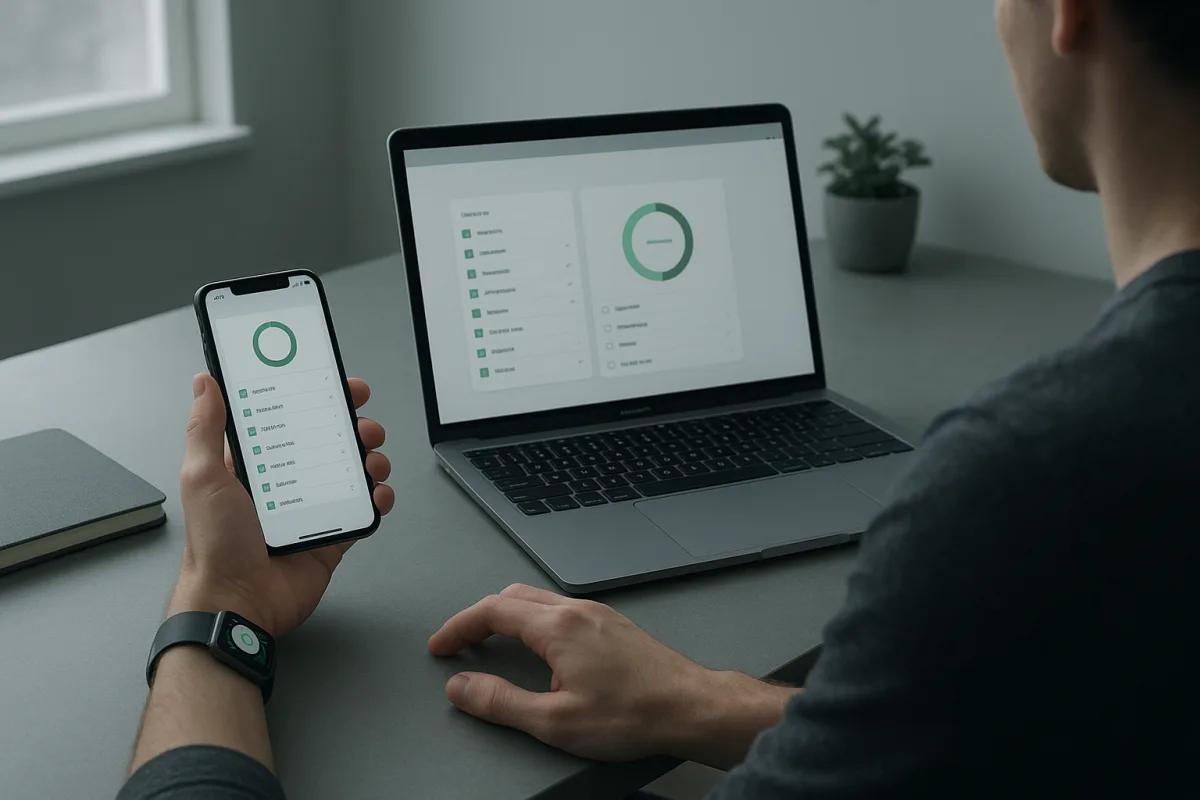
The useful choice here is between Habitify and Streaks, two premium-positioned habit trackers with almost opposite ideas about what a tracker should be. Habitify tries to be available everywhere. Streaks tries to disappear into an Apple-only routine.
That makes this less of a ratings contest. Streaks has been rated 4.8 out of 5 in the research brief, while Habitify is generally described as a leading cross-platform option rather than a direct design rival. [1][19] Both can record habits. The question is what you will still open on an ordinary Wednesday.
Habit tracking does not have a strong evidence base for app-specific outcomes. The available research supports the general point that habits often take longer than the familiar 21-day claim, averaging 66 days in one widely cited finding. [11] It does not show that one reminder design or streak display reliably produces better results.
There is also no credible average for how long daily tracking should take. Some app guides describe check-ins taking under 10 seconds, but that is not the same as evidence that a particular amount of app time works. [12] The sensible standard is low friction: record the behaviour, review occasionally, and avoid building a second job around administration.
Head-to-head comparison
| Criterion | Habitify | Streaks | Better fit |
|---|---|---|---|
| Platform availability | Native apps across iOS, Android, Mac, web, and Watch, with real-time sync reported. [[1]](https://humanpicks.com/blog/best-habit-tracker-apps.html?utm_source=openai "Best Habit Tracker Apps for 2026 | Human Picks") | iOS-exclusive, with iCloud export rather than broad cross-platform access. [[1]](https://humanpicks.com/blog/best-habit-tracker-apps.html?utm_source=openai "Best Habit Tracker Apps for 2026 |
| Daily interaction | A conventional habit dashboard intended to work across several devices. | A deliberately clean, focused Apple interface built around completing streaks. [19] | Streaks for less visual and organisational overhead |
| Reminders and scheduling | Supports reminders and a broader routine-oriented setup. [[1]](https://humanpicks.com/blog/best-habit-tracker-apps.html?utm_source=openai "Best Habit Tracker Apps for 2026 | Human Picks") | Handles recurring habit prompts within a simpler Apple-centred system. [19] |
| Goal flexibility | Built for habits across routines and devices, though the brief does not establish unusually deep goal analytics. | Strongest for a finite set of repeatable actions rather than elaborate projects. [19] | Close, depending on whether variety or simplicity matters |
| Health and ecosystem integration | Broad device coverage, but evidence for connections to productivity tools beyond health platforms is limited. [[1]](https://humanpicks.com/blog/best-habit-tracker-apps.html?utm_source=openai "Best Habit Tracker Apps for 2026 | Human Picks") | Particularly close Apple Watch and Apple Health integration. [19] |
| Offline use and syncing | Offline mode with syncing after reconnection is reported. [16] | iCloud-based Apple syncing, but the brief does not establish comparable offline behaviour. [[1]](https://humanpicks.com/blog/best-habit-tracker-apps.html?utm_source=openai "Best Habit Tracker Apps for 2026 | Human Picks") |
| Review and analysis | More useful when the benefit is seeing the same record from several places. | Progress is intentionally visual, not an extensive analytical system. | Neither for serious long-term analysis |
| Relative cost position | Premium-positioned, with a free tier that limits habit counts. [[1]](https://humanpicks.com/blog/best-habit-tracker-apps.html?utm_source=openai "Best Habit Tracker Apps for 2026 | Human Picks") | Premium-positioned, but its one-time-fee model sits apart from recurring subscription tools. [19] |
| Privacy certainty | No major documented breach in the supplied research, but no basis for declaring the app risk-free. | The same caution applies. Apple-only infrastructure does not prove stronger privacy practices. | No winner on available evidence |
1. Platform availability
Habitify wins this criterion plainly. It has native apps on iOS, Android, Mac, web, and Watch, with real-time syncing positioned as its central advantage. [1] If your phone is Android, your work machine is Windows, and you occasionally plan on the web, Streaks is not really in contention.
Streaks is for an Apple setup. That limitation is not necessarily a flaw. A tracker that only lives on the devices you already use can be calmer than one asking you to configure accounts, sync states, and duplicate notifications across several platforms.
The break point arrives when your device situation changes. A person moving between Android and iPhone, sharing a household computer, or relying on a browser at work should choose Habitify. Streaks is a poor fit if access from outside Apple hardware matters at all. [1]
2. Daily interaction
Streaks has the stronger case for someone who wants habit tracking to remain small. Its appeal is a clean visual design, an Apple Design Award pedigree, and an interface oriented around seeing whether today’s action is done. [19] That is enough for many habits.
Habitify asks more of the user, not necessarily in minutes, but in system maintenance. Cross-device access creates more places to check, more notification choices, and more opportunities to turn a simple record into a dashboard habit.
That is not a criticism if you genuinely use several devices. It is a warning for people who tend to over-configure. The tracker should be easier to open than the task it records. If the habit is “walk after lunch,” recording it should not become a separate planning exercise.
3. Reminders and scheduling
Habitify is the better option for people whose habits need a schedule rather than a generic daily tick. Its positioning emphasises routines, reminders, and cross-device availability, which matters when morning, workday, and evening behaviours are genuinely different. [1]
Streaks works best when the underlying instruction is already clear: take medication as prescribed, practise a language, walk, read, or complete a recurring workout. The app can prompt and record, but it is not the natural choice for someone trying to model a complicated changing calendar.
Neither tool replaces a calendar or clinical support. If missed habits relate to persistent low mood, sleep disruption, attention changes, compulsive behaviour, or medication, that is not a notification-setting problem. Discuss those symptoms with a doctor rather than trying to optimise your streak.
4. Goal flexibility
Habitify is more accommodating if your habits occur in several contexts. The same tracker can travel from a morning phone check-in to a desktop review, which is useful for routines tied to work, home, exercise, or travel. [1]
Streaks is better understood as a finite, visual list of things you want to repeat. That constraint can be useful. A long inventory of aspirational habits often creates guilt without producing a clear next action.
Neither is the obvious choice for detailed goal analytics. The mid-range app Strides is the field’s specialist for flexible goal and habit tracking with detailed analytics. [1] The premium app Way of Life is the stronger fit for long-term pattern visualisation. [1]
5. Health and ecosystem integration
Streaks wins for an Apple Health user. Its close Apple Watch and Apple Health integration is its defining practical feature, not merely a decorative extra. [19] If health data is already part of an Apple-based routine, fewer manual check-ins may make the tracker more usable.
Habitify’s advantage is wider availability, not proven superiority in every integration. Many habit apps advertise Apple Health or Fitbit links, but the brief finds that wider productivity-tool integration is inconsistent and often poorly documented. Do not buy either app assuming it will replace your task manager.
This distinction matters because “sync” is often used loosely. Habitify offers broad cross-device synchronization. [1] Streaks keeps its strength within Apple’s ecosystem. [19] Those are two different conveniences, and neither automatically means reliable integration with every service you already use.
6. Offline use and syncing
Habitify has the clearer reported offline proposition: it can work offline and sync once reconnected. [16] That is useful for travel, poor reception, or people who prefer to avoid making a routine dependent on a live connection.
Streaks uses Apple-centred syncing, but the supplied research does not establish comparable offline performance. That does not mean it fails offline. It means there is insufficient evidence here to promise equivalent behaviour.
Offline capability matters more than it sounds. A habit tracker should not lose its usefulness during a commute, flight, or patchy connection. Fully offline Android tools exist, but they generally trade that simplicity for the absence of cross-device sync. [16]
7. Cost and free-tier trade-offs
Both options sit in the premium tier of this field, but their cost models differ. Habitify’s free tier limits the number of habits, so it works as a trial but may become restrictive once you track several routines. [1]
Streaks is also premium-positioned, but its one-time-fee approach distinguishes it from apps that ask for a continuing subscription. [19] For some people, that is enough to decide the matter. Paying once is simpler than evaluating whether another recurring service earns its place each year.
The cheaper alternatives make different compromises. Loop Habit Tracker is entry-level because it is completely free, open-source, ad-free, and Android-only. [5] KUBBO is another entry-level choice, offering XP, Gold, city building, and an AI coach without a reported paywall on iOS and Android. [6]
8. Privacy and data caution
Neither Habitify nor Streaks earns a privacy winner from the evidence provided. The brief found no direct reports of major breaches involving the leading habit apps, but that is not proof that data practices are harmless or that future risk is absent.
This deserves more care where habits overlap with health, fertility, mood, medication, substance use, or mental health. Privacy concerns are well documented in related health-app categories, even if the same controversies have not been established for these specific trackers.
For a more privacy-centred design within this field, the mid-range app Habi is positioned around calendar-based tracking with local or iCloud sync and no data collection. [1] Readers should still check current app permissions and policies before putting sensitive information into any tracker.
The rest of the field, in practical terms
KUBBO is the entry-level choice for people motivated by game loops. It offers XP, Gold, city building, and an AI coach without a reported paywall, making it better for someone who wants rewards than a minimalist checklist. [6] It will not suit people who find game mechanics childish or distracting.
Loop Habit Tracker is the entry-level Android choice for someone who wants a free, open-source, ad-free, fully offline tracker. [5][16] It is a poor fit for iPhone users and anyone who needs live cross-device syncing.
Habitica is mid-range and turns tasks and habits into an RPG with quests, parties, and boss battles. [4] It suits users who will return for social play and visible progression. Its gamification may support retention, but it can be excessive for people who only want to mark a habit done. [12]
Productive is mid-range and best suited to people who need structured scheduling and customised reminders. [9] Its free tier reportedly limits users to three habits, so it is less attractive for broad tracking without paying. [1]
Strides is mid-range for people who need flexible goals alongside habits and want detailed analytics. [1] It is more appropriate for measurable targets than for someone seeking the lowest-friction daily check-in.
Habi is mid-range for privacy-conscious users who prefer calendar-based tracking, local or iCloud sync, and a stated no-data-collection approach. [1] It suits an Apple-leaning user who values a record over gamification.
Done is premium and suits visual minimalists who prefer colour-coded progress bars and multi-count goals. [1] It is a reasonable alternative when “drink water several times” matters more than maintaining a simple once-a-day streak.
Way of Life is premium and suits users who care about long-term analysis and pattern visualisation. [1] It is likely more useful for periodic review than for someone who wants the shortest possible daily interaction.
Fhynix is premium and best suited to people who want calendar integration to be central to habit tracking. [1] Choose it when habits need to sit beside appointments, rather than in a separate streak-focused space.
Who each option suits
Choose Habitify if you use more than one operating system, want real-time cross-device access, or need offline check-ins that sync later. It suits people whose routines genuinely happen across phone, desktop, web, and watch. [1][16]
Habitify does not suit the person who wants a tracker to stay almost invisible. Its broader availability and greater setup potential can create more system than the habit itself requires. It is also less appealing if a limited free tier is all you intend to use. [1]
Choose Streaks if you are fully on Apple devices, value Apple Health and Apple Watch integration, and want a clean visual reminder of a small set of recurring actions. [19] It is the better choice when simplicity is the feature you are buying.
Streaks does not suit Android users, mixed-device users, or anyone who needs web access. Its Apple-only design is precisely why it feels focused, but it is also the boundary that makes the decision easy for many people.
Frequently Asked Questions
Which are the best habit tracking apps for multiple devices?
Habitify is recommended for users who want to track habits across multiple devices, including iPhone, Android, Mac, web, and Apple Watch. It offers real-time syncing and native apps on these platforms, making it suitable for mixed-device households or work setups.
How do Habitify and Streaks compare as habit trackers?
Habitify is a broader tool available across many platforms with a conventional dashboard and more flexible scheduling. Streaks is simpler, Apple-exclusive, and designed to integrate closely with Apple Health and Apple Watch. The choice depends on whether you prefer cross-device access (Habitify) or a streamlined Apple-only experience (Streaks).
What habit tracker app works best with Apple Health?
Streaks works best with Apple Health due to its close integration with Apple Watch and Apple Health platforms. It is designed specifically for Apple devices and offers a clean interface focused on completing streaks within the Apple ecosystem.
Are habit tracking apps effective for long-term habit formation?
Habit tracking apps alone are unlikely to guarantee habit formation. Research shows that habits take an average of 66 days to form, and over half of habit-tracking app users stop using them within 30 days. Effectiveness depends more on consistent use and low friction than on specific app features.
Which habit tracker app is better for offline use and syncing?
Habitify supports offline mode with syncing after reconnection, making it suitable for travel or unreliable internet connections. Streaks relies on iCloud syncing but does not have established offline functionality comparable to Habitify.
How we researched this
This article was assembled from 19 cited references.
Nothing here is based on hands-on testing. Where a figure or finding appears, it belongs to the source cited beside it, and the writing says so rather than implying otherwise. Every source is listed below so you can check it.
Sources
- Best Habit Tracker Apps for 2026 | Human Picks
- 11 Best Goal Setting Apps for 2021 - Habit Trackers for iOS & Android
- The 12 Best Habit Tracking Apps in 2023
- Is Habitica Free? Habitica Pricing, Plans and Costs (2026)
- Best Free Habit Tracker Apps for iPhone and Android in 2026 - Habitz Blog
- 6 Best Free Habit Tracker Apps in 2026 (No Paywall)
- Best Habit Tracker Apps: 10 Tools Backed by Research (2026)
- Ditch the February resolution slump with this habit-tracking powerhouse
- Productive - Daily Habit Tracker
- The 5 best habit tracker apps in 2021 - purshoLOGY
- 30+ Habit Statistics (2026): Why Most Habits Fail | Habi
- The State of Habit Tracking in 2026: Trends and Data
- Habit Tracking Apps Market Growth, Size & Trends Analysis 2035
- Best Habit Tracker Apps 2026 — Build Better Routines — BMcks Apps
- Best Habit Tracker Apps in 2026: Honest Comparison of 8 Popular Options | HabitStreak | HabitStreak
- Habit Apps That Work Offline (2026) - Routine & Habit Tracker App Tips
- 12 Best Habit Tracker Apps in 2026 (Stay Consistent)
- Productive
- streaks habit tracker App - App Store
Related Articles
Time Management Apps Comparison: Todoist vs Toggl Track
Explore a detailed comparison of time management apps Todoist and Toggl Track, focusing on features, pricing, and user experience.
Best Project Management Tools
Compare the best project management tools in 2026, focusing on ClickUp and monday.com to find the right fit for your team’s needs.

Anki vs NoteGPT: Best Productivity Tools for Students
Compare Anki and NoteGPT to find the best productivity tools for students focused on memorization and note summarization.
Effective Habit Tracking Methods for Lasting Progress
Discover effective habit tracking methods using hybrid systems and feedback loops to build lasting habits and improve productivity.