
Morning Routine for Success: How to Build Effective Habits
Learn how to create a morning routine for success with proven habits like consistent wake times, hydration, light exposure, and phone boundaries.
Set a wake time you can actually keep
Your morning routine starts the night before, with a wake time that survives a late meeting, a child waking up early, or a Wednesday when you have no motivation. Pick the time you need to begin your day, not an aspirational 5 a.m. identity.
Correla, a habit-tracking platform, reports that keeping wake time variance below 30 minutes is associated with a 27 percent productivity increase. That is app-based data, not a clinical rule, but it supports choosing regularity over an elaborate sequence. [23]
Work backward from that wake time. One guide recommends seven to nine hours of sleep, and suggests that waking after roughly 90-minute sleep cycles may feel more refreshing, such as waking at 6:45 a.m. after 7.5 hours asleep. [24]
Treat those numbers as planning prompts, not a diagnosis or a reason to cut sleep short to hit a cycle. If you are dealing with ongoing sleep difficulties, daytime fatigue, or concentration problems, bring those concerns to a doctor.
We would begin here because a routine built on an inconsistent wake time asks you to renegotiate every other habit each day. A stable 6:45 a.m. with three modest steps will usually outlast a perfect routine performed twice a week.
Protect the first 45 minutes from your phone
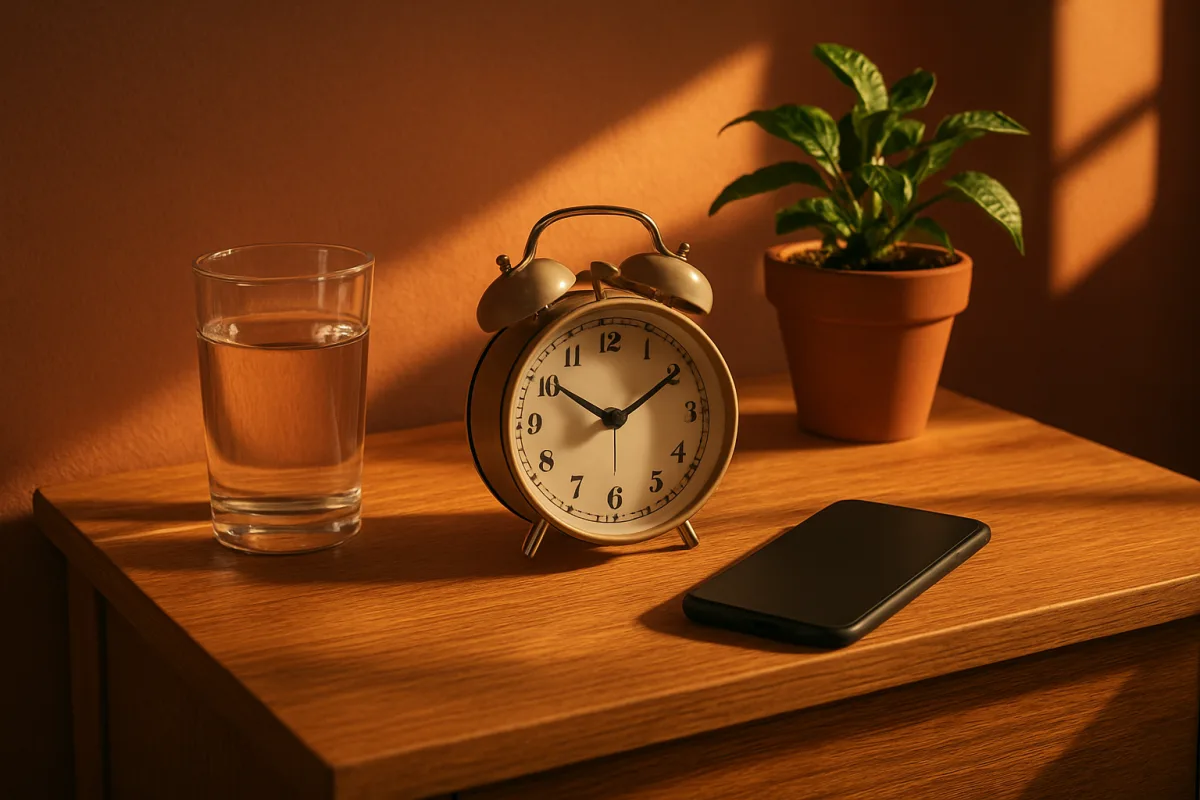
Put the phone beyond arm’s reach before you sleep, ideally somewhere that requires you to stand up to turn off the alarm. Your goal is not digital purity. It is to stop messages, news, and feeds from assigning your first task.
Tom’s Guide reports that checking a smartphone immediately after waking can worsen grogginess and disrupt focus, with experts recommending a 30- to 45-minute delay before phone use. [2] Set an alarm, then leave notifications for later.
This may require a replacement for the automatic reach toward the nightstand. Put a glass or bottle of water where the phone usually sits, lay out walking clothes, or leave a written card that says what happens next.
Do not create a loophole by using the phone for “just one quick check.” If you need it for music, a timer, or a transit update, prepare that function the night before and avoid opening email, social apps, or work chat.
Drink water before making decisions
Make hydration your first completed action: pour or prepare 500 to 750 milliliters of water, then drink it after getting up. The Edge State recommends that range to support mental clarity. [3]
This habit earns its place because it has almost no setup, no special equipment, and no requirement to become a person who enjoys dawn workouts. Keep a bottle filled by the bed or make filling the kettle the cue.
You do not need to turn hydration into a challenge or calculate every sip. The aim is a reliable transition from sleep to being upright, before your day becomes a series of decisions and requests.
If drinking that amount immediately is uncomfortable, start with less and build a version you will repeat. The routine needs to fit your body and your morning, and medical questions about fluid intake belong with a doctor.
Get light that matches the season
Go outside within 30 minutes of waking, ideally before work begins. Morning light exposure of five to 20 minutes is commonly recommended for circadian alignment and alertness. [4][9]
The exact duration cannot be fixed for every location and season. Tom’s Guide cites doctors who recommend at least 15 minutes of sunlight and report energy gains of roughly 15 to 20 percent, while LightOtter advises 25 minutes outside after sunrise in long winter conditions. [2][7]
Use the shortest workable version on ordinary days: step outside with your water, walk around the block, stand on a porch, or take a coffee-free commute on foot. On dark winter mornings, plan more time if conditions allow.
Do not wait for a bright, cloudless day. The action is getting outdoor morning light into your routine, not creating a scenic ritual. If your schedule makes sunrise impossible, keep the wake time steady and structure the rest of the routine consistently.
Delay coffee instead of using it as your alarm
If coffee is part of your morning, do not make it the first thing you consume. The Edge State and CryoCove recommend waiting roughly 90 to 120 minutes after waking, arguing that this timing better fits cortisol rhythms and may reduce later energy crashes. [3][13]
That recommendation will not suit every commute, childcare schedule, or work start time. It is an expert recommendation, not a universal finding, so test whether delaying coffee makes your morning easier without forcing an unworkable gap.
The simplest arrangement is water and outdoor light first, then coffee after you have washed, dressed, walked, or completed your first small work step. This gives the delay a practical boundary rather than turning it into clock-watching.
We would not add cold showers, supplements, or a complicated drink protocol here. There is no need to make caffeine timing another project before you have established a consistent wake time and phone boundary.
Choose one activation habit
Pick one action that changes your state from half-awake to ready to begin. For some people, that is a short walk. For others, it is stretching, a few minutes of quiet sitting, or a shower.
Correla reports that moderate exercise before 9 a.m. correlates with 1.5 additional hours of focused work. Because that figure comes from app-based analytics, it describes an association among users, not a guarantee that a workout will produce extra work time for you. [23]
If movement is realistic, make the target small enough for a weekday: a 10-minute walk after light exposure, a short bike ride, or a preplanned moderate session. Avoid designing a workout that requires equipment, travel, and a heroic amount of time.
Meditation is optional. Guides often suggest five to 10 minutes of meditation, but the ideal timing and effect have not been universally validated. [3][4] Keep it only if it helps you begin the day, not because every productive person appears to do it.
Write down the day’s first real task
Before opening your inbox, write one sentence naming the work that deserves your clearest attention. It can be “draft the client proposal,” “solve the budget issue,” or “write the first 300 words,” but it cannot be “catch up.”
A five-minute journal practice is associated with an 18 percent reduction in afternoon stress in Correla’s data. No finding specifically establishes a productivity gain from morning journaling, so use the page to clarify work, not to promise yourself a calmer personality. [23]
Write three lines: the day’s important task, the next visible action, and anything likely to derail it. For example: “Proposal. Open the outline and write the recommendation section. Do not check Slack until the draft exists.”
This turns planning into a handoff between your morning routine and your workday. A longer planning session may help some people, but suggested 10- to 15-minute planning windows are not universally validated. [3][4]
Start important work before low-value work expands
Once you are at your desk, begin the task you named before responding to routine messages. Jobiety identifies spending peak cognitive hours on low-value tasks as a common productivity mistake. [11]
Make the first block concrete. Open the document, spreadsheet, design file, or task list you need, then set a boundary such as completing one section, making three calls, or working until the next scheduled obligation.
Email and chat feel productive because they offer immediate completion. They also invite other people’s priorities into the part of the day you intended to protect. You do not need to ignore communication all morning, only delay it long enough to make progress first.
If your role requires immediate responsiveness, choose a shorter protected block. Fifteen minutes of proposal work before checking messages is still a different morning from spending the first hour reacting to incoming requests.
Build a routine that fits in 15 minutes first
Do not start with journaling, meditation, exercise, a cold shower, a full breakfast, reading, language study, and a detailed plan. Athenify warns that overloaded morning routines are harder to sustain and recommends beginning with one or two manageable habits. [12]
A 15-minute minimum version could be: get up at the planned time, drink water, step outside for light, and write the day’s first task. On a less pressured day, add a walk or a longer planning block.
Some guides recommend total morning routines lasting 60 to 90 minutes, but the optimal duration varies by person and schedule. [5] A routine that consistently ends before your commute, school drop-off, or first meeting is the one we would keep.
Make each step easy to resume after disruption. Keep shoes by the door, use a paper notebook, fill the water bottle at night, and decide your first work task before you close the previous day.
Adapt the sequence for remote and shift work
If you work remotely, create a visible boundary between waking and logging on. Get dressed, take light exposure outside, and avoid opening work chat from bed, even if your desk is ten feet away.
Remote-work guides commonly recommend a short, structured start, including a 15-minute version for people who begin work quickly. [19][22] Use that constraint to your advantage: protect the few actions that separate personal waking time from work time.
Shift work needs a different approach. A physiology-based mathematical model for shift workers focuses on alertness timing, which supports organizing sleep environment, planned light exposure, and routine structure around your actual shift instead of copying a daytime schedule. [1]
There is no direct guidance here for every irregular freelance, gig, or rotating schedule. Keep the core sequence attached to your wake time, whenever that occurs: water, light when available, no immediate phone spiral, then one clear first task.
Review the routine after two weeks
Run your minimum routine for two weeks before adding anything. Track only whether you got up near your chosen time, delayed phone use, got outside, and started important work before low-value tasks.
If one step repeatedly fails, reduce its demands. A 20-minute run can become a 10-minute walk, and a full journal page can become three lines. Failure usually means the design asks too much of a real morning.
Habit and routine apps can track streaks, reminders, and sequences, but reviews note that effectiveness and adherence vary between users, while cost-benefit analysis is limited. [15][16][17][18] We would use a paper checklist or existing calendar reminder before paying for another system.
Keep the parts that reliably get you from bed to meaningful work. The routine has done its job when it makes the day easier to begin, not when it gives you a longer list of things to complete before work starts.
Frequently Asked Questions
How do I create a morning routine for success?
Start with one or two simple actions that fit before your main obligations begin, rather than trying to complete a long routine. Choose a wake time you can keep within 30 minutes most days and build habits around that stable schedule. This consistency helps make routines sustainable and more effective.
What are the best habits to include in a morning routine?
Begin by drinking 500 to 750 milliliters of water soon after waking to support mental clarity. Get outside within 30 minutes for at least 5 to 20 minutes of natural light to help align your circadian rhythm and boost alertness. Avoid checking your phone for the first 30 to 45 minutes to prevent grogginess and distractions.
How can I avoid distractions in the morning?
Keep your phone out of arm’s reach and delay using it for at least 30 to 45 minutes after waking. Prepare any needed functions like music or timers the night before to avoid opening email or social apps early. Save low-value tasks such as emails and messages until after you have started your most important work.
Why is a consistent wake time important for success?
Maintaining a wake time with less than 30 minutes of variation is linked to a 27 percent increase in productivity. A consistent wake time stabilizes your circadian rhythm and reduces the need to renegotiate your routine each day, making habits easier to maintain and your day more focused.
When should I drink water and coffee in the morning?
Drink water immediately after waking as your first completed action to help transition from sleep to wakefulness. Delay coffee consumption for about 90 to 120 minutes after waking to align better with your body's natural cortisol rhythm and avoid energy crashes later in the day.
How we researched this
This article was assembled from 24 cited references.
Nothing here is based on hands-on testing. Where a figure or finding appears, it belongs to the source cited beside it, and the writing says so rather than implying otherwise. Every source is listed below so you can check it.
Sources
- Alertness Optimization for Shift Workers Using a Physiology-based Mathematical Model
- The 15-minute sunlight rule ended my morning energy slump and brain fog - and it can increase energy levels by 20%, doctors say
- Morning Routine: The Evidence-Based Protocol
- Best Morning Habits for Productivity (Backed by Research)
- Morning Routine for Productivity 2026: Boost Your Day
- Morning Routine: Science-Backed Strategies for Energy
- How LightOtter works, method and sources
- Morning routines: what the science actually says, esenza
- Best Morning Routines to Prime Your Brain in 2026 | Neurosity
- The Morning Routine for Maximum Productivity: Full Checklist & Tips, CAFELY
- 7 Common Productivity Mistakes That Are Wasting Your Time | Jobiety
- Morning Routines That Eliminate Study Procrastination, Athenify
- Morning Routine Optimization Guide, Science-Backed Protocols for Energy & Focus | CryoCove | CryoCove
- 12 Morning Routine Mistakes Hurting Productivity
- Best Habit Tracking Apps 2026: Build Better Habits
- Best Daily Routine Apps for iPhone in 2026 - HabitLuma
- Best Morning Routine Apps (2026) | NoScrollHome Blog
- Morning Routine Apps: 7 Picks That Run the Sequence (2026)
- Work From Home Productivity: Proven System (2026) | Remote Jobs Library
- The Best Morning Routine for Remote Workers in 2026 - Remote Work Setup
- Remote Work Morning Routine: 7 Practical Steps | RemoteNest
- Morning Routine for Remote Workers: A Practical 15-Minute Start, The Global Worker
- Morning Routines and Productivity Data | Correla · Correla
- Ideal Morning Routine for Productivity and Focus
Related Articles

Mastering the Attention Economy: Break Free from Digital Distractions
Better Than Yesterday explores the attention economy, revealing how technology manipulates our focus for profit. Learn to break free from digital distractions, reclaim control over your attention, and boost creativity by embracing moments of boredom. Master your digital habits for a clearer, more energized mind in today's fast-paced world.

Master Shaw Hungi: Overcoming Hindrances and Finding Purpose
Master Shaw Hungi, a renowned monk, shares insights on overcoming hindrances and finding purpose in a chaotic world. Emphasizing self-reflection, balance, and connection to a universal source, he offers wisdom on mental well-being and living authentically.

Jordan Peterson's Wisdom on Love, Conflict, and Identity in Modern Relationships
Delve into the complexities of modern relationships and the wisdom of Jordan Peterson on love, conflict, and identity in this enlightening episode of The Diary Of A CEO. Explore the impact of pre-marriage cohabitation, the importance of embracing challenges, and the interconnected nature of emotions and social connections. Peterson's insights on sacrificial relationships and the pursuit of higher goals offer a roadmap to navigating the chaos of life.
How to Create a Personal Productivity Dashboard That Works
Learn how to create a personal productivity dashboard with key metrics, project tracking, and review tips to boost your focus and progress.