
How to Create a Personal Development Plan That Works
Learn how to create a personal development plan with clear goals, weekly milestones, and habit strategies to boost your growth and productivity.
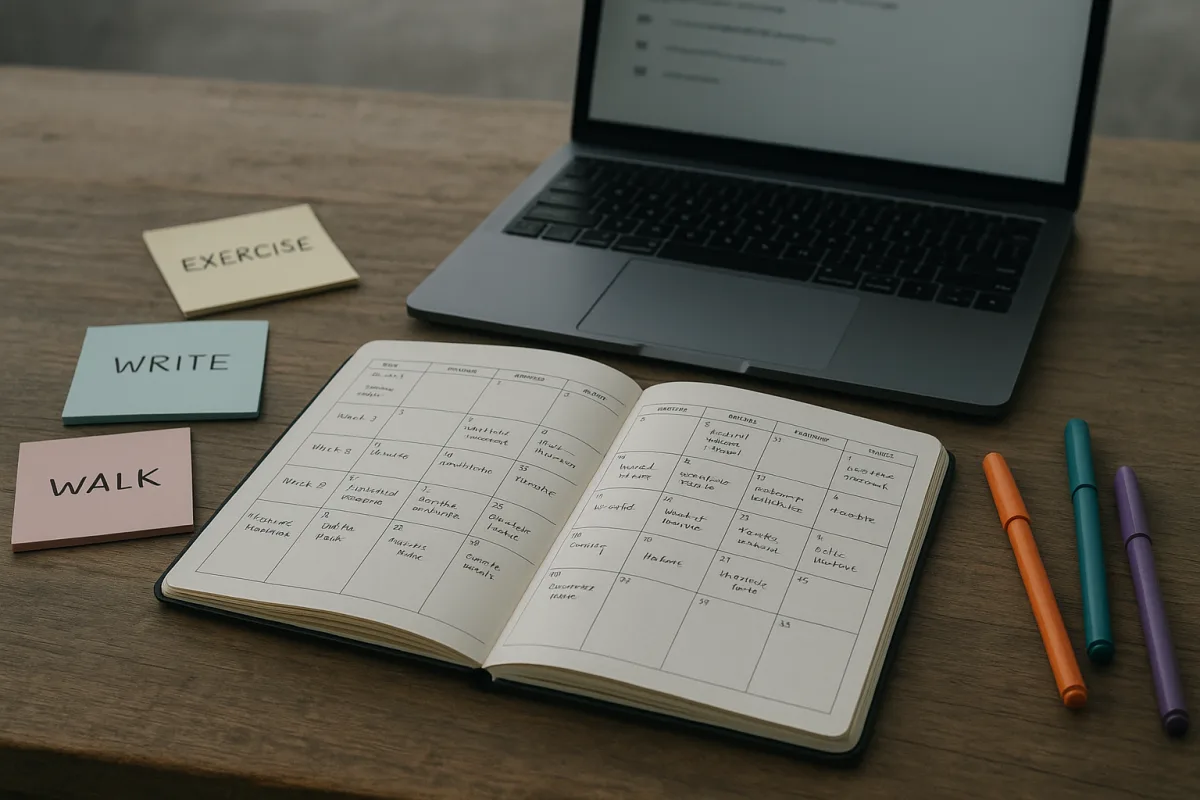
The first problem: deciding what “personal growth” means this year
A personal development plan fails early when it begins with categories rather than a decision. “Career, health, confidence, finances, relationships” looks comprehensive, but it gives you five places to feel behind and no instruction for Tuesday morning.
Start with a self-assessment that identifies one area where change would have a practical effect. Structured journaling and assessment tools such as CliftonStrengths are commonly used for this stage. [3] The point is not to discover a permanent identity label. It is to describe your current position clearly enough to choose.
Write answers to four prompts: What task do I avoid or struggle with repeatedly? What skill would make my current work or life easier? What evidence shows this matters now? What am I prepared to do each week for it?
Keep the evidence concrete. “I want better communication” is too broad to plan. “I need to run clearer project update meetings because colleagues regularly ask for decisions and deadlines afterward” gives you something observable to improve.
Do not turn this assessment into amateur diagnosis. If low mood, persistent exhaustion, disrupted sleep, anxiety, or concentration problems are part of what you are noticing, they deserve discussion with a doctor or qualified clinician. A personal development plan is not a treatment plan.
Turn the priority into an anchor goal
Once you have chosen an area, name one anchor goal for the next six to 12 months. This is long enough for meaningful skill-building, but close enough that you can connect it to current work and commitments. [1]
The useful version of an anchor goal is specific and bounded. For example: “By 30 September, I will be able to lead a 30-minute project status meeting using a written agenda, decisions log, and follow-up note for each meeting.”
That goal can be checked without relying on a feeling of improvement. It also says what the work is, what a finished version looks like, and when you will reassess it. Those are the practical strengths of the SMART framework: specific, measurable, achievable, relevant, and time-bound. [2]
“Become more confident” is not a SMART goal because there is no agreed finish line. It may be an understandable hope, but it cannot tell you what to practise this week or whether a course, mentor, or repeated exposure is helping.
Achievable does not mean easy. It means the goal fits the time, money, authority, and energy you actually have. A plan requiring five evening classes each week is not more serious than one requiring two focused sessions. It is simply more likely to collide with a normal week.
Time estimates deserve some skepticism. Psychology Today notes the familiar tendency toward optimism in planning. [10] Before accepting a deadline, look at a real calendar, include existing obligations, and assume interruptions will occur.
Break the goal before motivation becomes the bottleneck
An anchor goal is still too distant to guide daily behaviour. The next job is to create short targets of one or two weeks, then decide which actions belong on your calendar. [1][5]
For a quarterly plan, the research brief recommends one primary goal and 12 weekly milestones. [5] That means each milestone should be small enough to complete or revise within a week, not a miniature annual ambition.
For the meeting example, the first four weekly milestones could be: collect two good agenda examples, draft an agenda template, ask a colleague for feedback, then use the template in one real meeting. The work progresses through visible outputs.
Each milestone needs four fields: the action, the deadline, the resource required, and the evidence of completion. “Work on communication” has none of these. “Complete module two by Friday, using the course workbook, and save the finished exercise” has all four.
This is where plans commonly become decorative. They contain ambitions, quotes, colour-coded categories, and perhaps a future self portrait, but no answer to the dull logistical question: when will the next action happen?
Put the action in an existing slot. If you cannot identify a plausible 20-minute or 45-minute window, reduce the milestone or defer it. A plan that requires fictional free time creates a predictable cycle of postponement and rewriting.
Make the daily action smaller than the goal
Goals describe direction. Habits do the repetitive work. The most usable habit methods in the brief are habit stacking, implementation intentions, small starting actions, tracking, and environmental design. [11][12][17]
Habit stacking means attaching a new action to one you already perform. For example: “After I make my first coffee on Tuesday and Thursday, I open the course and complete one exercise.” The existing action provides the cue. [11]
Implementation intentions make the cue and response even more explicit: “When X happens, I will do Y.” Research-oriented habit guidance identifies these plans alongside habit stacking as among the better-supported behaviour-change techniques. [12]
Start at an almost inconveniently small scale. Read one page, write three lines, send one message, or spend five minutes preparing the material. The purpose is not to pretend five minutes completes serious learning. It is to make starting possible on an ordinary day. [13][17]
Change the environment where possible. Keep the workbook open, place the language notes beside breakfast, or block distracting websites during a planned study session. Environmental cues reduce the number of decisions required at the moment of action. [17]
This is not a claim that every habit can be engineered into existence. Shift work, caring responsibilities, disability, unstable schedules, and stress can make fixed cues unreliable. In those cases, use a flexible rule, such as completing two sessions before Sunday, rather than insisting on a daily streak.
Choose tracking that answers a question
Tracking is useful when it answers, “Did I do the planned action?” or “What is stopping it?” It becomes noise when it asks you to record every self-improvement impulse without changing your next decision.
A paper checklist is enough for many plans. If you want an app, choose one based on the job rather than the promise of motivation. The brief lists Breathwrk with a free tier for guided breathing routines, TickTick at $2.79 per month for tasks and habits, and Streaks, which has a 4.5 user rating, for simple repeated actions. [1]
RescueTime costs $12 per month and is suited to people who need a record of where computer time goes, rather than another to-do list. Forest, rated 4.6 by users, is aimed at reducing phone distraction during a focused session. [1][4]
Those prices are subscription or app costs, not proof that a tool improves outcomes. The supplied sources do not establish that one named app produces better personal growth results than a calendar, notebook, or spreadsheet. Pick the smallest system you will review.
For goal-level tracking, Perdoo is listed at $9 per user per month and Tability at $6 per user per month. Weekdone is available free. [1][15] These platforms suit shared goals or structured team-style reporting more than a single private habit.
A useful rule is to track outputs before outcomes. Record “three practice presentations completed” before trying to score “confidence.” Outputs give you material for a review. Outcomes often change slowly and can be influenced by factors outside the plan.
Set up reviews before you need one
Weekly reviews are recommended because a plan needs regular adjustment, not because every week should look impressive. [14][18] Reserve 15 to 20 minutes and answer: What was completed? What was missed? What made it difficult? What is the next smallest action?
At the monthly review, compare completed milestones with the original short-term goal. Decide whether to continue, simplify, seek help, or change the timeline. A missed milestone is information about scope, scheduling, or resources, not a character verdict.
Use quarterly reviews for the larger question: is this still the right primary goal? A quarterly system built around one main objective creates room to change course without abandoning the whole plan after a difficult fortnight. [5]
An annual review can repeat the self-assessment, update longer-term goals, and remove projects that no longer fit. The recommended cadence is weekly check-ins, monthly milestone reviews, quarterly reflection, and an annual plan update. [14][18]
Accountability can make the review harder to skip, but it should match the work. A monthly conversation with a manager may suit a professional skill goal. A friend receiving a brief Friday update may be enough for a self-directed course.
Decide whether you need paid support
Do not buy coaching because the plan feels vague. First, identify the missing ingredient: knowledge, feedback, structure, access to practice, or accountability. A course may solve a knowledge gap. A mentor may solve a feedback gap. Neither is automatically necessary.
Online personal development courses are listed in a broad $19.99 to $95 range, including options from providers such as Udemy and Coursera. [7] University-backed courses are also available through institutions including MTF Institute, the Open University, and Unicamp. [7]
Coaching costs much more and vary sharply by specialty. Life and wellness coaching are listed at $75 to $250 per hour, career coaching at $100 to $300, executive coaching at $150 to $600, and business coaching at $200 to $750. [8][9]
A three-month package with weekly $300 sessions comes to roughly $3,600. [8] Group coaching, listed at $50 to $150 monthly, and online packages at $100 to $400 monthly may cost less, but still need a clear purpose. [8]
Before paying, ask what happens between sessions, what deliverable you will produce, how progress will be measured, and what credentials or relevant experience the coach has. If those answers are vague, a written action plan and a trusted accountability partner may be the better first step.
Adapt the plan to the people and culture around it
A plan does not operate outside culture. The brief notes differences in time perception, decision-making pace, and feedback styles, including more direct feedback norms in the Netherlands and Germany and more indirect norms in Japan and Thailand. [16]
This matters when your goal depends on other people. If feedback is usually indirect in your workplace, “ask for honest feedback” may produce polite ambiguity. Ask instead: “What is one thing I should keep, and one thing I should change before the next meeting?”
Likewise, do not mistake a slower group decision process for personal failure to act. Build longer consultation time into milestones where it is normal, and agree on what counts as a decision before setting a deadline.
There is no basis in the supplied research for assuming a universal personal development template will fit every setting. [16] Keep the structure, but adapt timelines, accountability, communication, and feedback requests to the environment where the plan has to work.
Frequently Asked Questions
How do I start creating a personal development plan?
Begin with a self-assessment to identify one specific area where change would have a practical effect. Use structured journaling or tools like CliftonStrengths to clarify your current position and choose a focused priority. Avoid broad categories and instead answer concrete prompts about tasks you avoid, skills you need, and what you can commit to weekly.
What are the key steps in a personal development plan?
Key steps include selecting one anchor goal for 6 to 12 months that is specific and measurable, breaking it down into 1-to-2-week targets, and scheduling actions on your calendar. Regularly review progress weekly, assess milestones monthly, reconsider priorities quarterly, and update the overall plan annually. Use SMART criteria to ensure goals are clear and achievable.
How can I set achievable goals in my personal development plan?
Set goals that are specific, measurable, achievable, relevant, and time-bound (SMART). Make sure the goal fits your available time, energy, and resources realistically by reviewing your calendar and existing commitments. Avoid vague goals like “be more confident” and instead define observable outcomes, such as leading a specific type of meeting by a certain date.
How do I break down long-term goals into weekly milestones?
Divide your 6-to-12-month anchor goal into 12 weekly milestones for a quarterly plan. Each milestone should be a small, concrete step that can be completed or revised within a week, producing visible outputs. For example, milestones might include researching examples, drafting templates, seeking feedback, and applying new skills in real situations.
What habit techniques help maintain a personal development plan?
Effective techniques include habit stacking, which links new habits to existing routines, and implementation intentions that specify “when X happens, then I will do Y.” Starting with very small goals helps ensure consistency, and using digital habit tracking tools provides immediate feedback and reinforcement. Designing your environment to support these habits also increases adherence.
How we researched this
This article was assembled from 18 cited references.
Nothing here is based on hands-on testing. Where a figure or finding appears, it belongs to the source cited beside it, and the writing says so rather than implying otherwise. Every source is listed below so you can check it.
Sources
- Your Personal Development Plan: A Data-Driven Roadmap - Made Me Mine
- Goal Setting: The 2026 SMART Framework Guide
- Personal Growth Assessment Guide
- The Forest App Will Help You Stay Off Your Phone
- 90-Day Goal Plan: The Quarterly System That Actually Works | Yourdec · yourdec
- 4 Simple Money Targets to Aim for in 2026 (And How to Hit Them), From a Financial Planner
- 25 Best Personal Development Courses Online (2026) | CourseAsk
- How to find a personal development mindset coach - Toxigon
- How Much Does a Personal Trainer Cost? 2026 Rates
- Too Optimistic in Time Planning? | Psychology Today
- Habit Stacking: The Psychology Behind Building Habits That Actually Stick | Simply Psychology
- Habit Stacking and Implementation Intentions: The Most Evidence-Backed Habit-Building Techniques | Good.You
- Science-Backed Habits for Success | 2026 Guide
- How to write & manage personal development plans (PDPs) | TSW Training
- Weekdone - 無料・ダウンロード
- "Direct vs Indirect Feedback Across Cultures"
- How to Create Healthy Habits in 2026: A Science-Backed, Practical Guide
- Personal Development Plan (PDP): Complete Guide
Related Articles

How to Create a Vision Board for Goals That Work
Learn how to create a vision board for goals with clear actions, focused images, and tips to boost productivity and follow-through.
Tony Robbins: NLP Pioneer Transforming Lives for 48 Years
Tony Robbins shares his journey from therapy observer to NLP pioneer, challenging skeptics and transforming lives with rapid interventions. His impactful work extends to elite athletes, politicians, and global leaders, marking 48 years of groundbreaking success.

Mastering Success: Tony Robbins' Five to Thrive Method
Tony Robbins reveals the "Five to Thrive," emphasizing the impact of physiology, focus, and language on shaping our mental state for success. Through incantations and repetition, he highlights the power of consistency and emotional intensity in achieving goals.

How to Set Achievable Work Goals for Better Productivity
Learn how to set achievable work goals using SMART criteria, time blocking, and prioritization to improve focus and get work done.